
These pages chronicle the work and ruminations of Carolyn Collins Petersen, also known as TheSpacewriter.
I am CEO of Loch Ness Productions. I am also a producer for Astrocast.TV, an online magazine about astronomy and space science.
For the past few years, I've also been a voice actor, appearing in a variety of productions. You can see and hear samples of my work by clicking on the "Voice-Overs, Videos and 'Casts tab.
My blog, TheSpacewriter's Ramblings, is about astronomy, space science, and other sciences.
Ideas and opinions expressed here do not represent those of my employer or of any other organization to which I am affiliated. They're mine.
Visit my main site at: TheSpacewriter.com.
**I encourage comments and discussion; please keep it polite and respectful. I do moderate them to weed out spam, but I also refuse to post any messages that contain harassing, demeaning, rude, or profane language. I run a respectable establishment here.
Contact me for writing and voice-over projects at: cc(dot)petersen(at)gmail(dot)com
I Twitter as Spacewriter
Blog entry posting times are U.S. Mountain Time (GMT-6:00) All postings Copyright 2003-2011 C.C. Petersen
Spacewriter’s Recent Posts
- Writing about Astronomy
- The End of the Kepler Mission?
- Using the Sky
- A Little Solar Activity
- All Hail Albertus Alauda
- Hubble Spots Comet ISON
- The Once and Future Universe
Archives
- ► 2013 (34)
- ► 2012 (78)
- ► 2011 (107)
- ► 2010 (95)
- ► 2009 (225)
- ► 2008 (291)
- ► 2007 (114)
- ► 2006 (72)
- ► 2005 (56)
- ► 2004 (96)
- ► 2003 (74)
- ► 2002 (21)
Calendar
| S | M | T | W | T | F | S |
|---|---|---|---|---|---|---|
| « Nov | Jan » | |||||
| 1 | 2 | 3 | 4 | |||
| 5 | 6 | 7 | 8 | 9 | 10 | 11 |
| 12 | 13 | 14 | 15 | 16 | 17 | 18 |
| 19 | 20 | 21 | 22 | 23 | 24 | 25 |
| 26 | 27 | 28 | 29 | 30 | 31 | |
Like space music?
Check out my favorite
space music artist:
Geodesium
at Geodesium.com
Blogroll
- 21st Century Waves - Technology Booms and Human Expansion Into the Cosmos
- About.Com Space/Astronomy
- Adot’s NotBlog
- Astroengine.com
- Astronomy Blog
- Astronomy Cast
- Badastronomy.Com
- Blooloop
- BLooloop: CCP
- Captain Disillusion
- ChandraBlog - Chandra X-ray Telescope
- Cosmic Log
- Cosmic Mirror
- Cosmic Variance
- Cosmos4u
- Discovery Space
- DP’s Astronomy Blog
- EurekAlert
- European Southern Observatory
- Friends of the Griffith Observatory
- Gemini Observatory
- Griffith Observatory
- Hairy Museum of Natural History
- Hubble Space Telescope
- Kids Directory
- Loch Ness Productions - Cosmic content
- Loch Ness Productions on Facebook - the world’s foremost fulldome video producer for planetarium shows
- Mike Brown’s Planets
- MIT/Haystack Observatory
- MWA Vodcast
- NASA Climate Change
- National Public Radio
- Observing the Sky
- One Astronomer’s Noise
- Pharyngula
- Prince of Pithy
- Science Made Cool
- Significant Snail
- Solar System Watch
- Space Times News
- Space Weather FX Vodcasts
- Star Stryder
- Stop Unethical Recission
- String Theory
- The Daily Galaxy
- The Mathroom (possibly NSFW)
- The Meridiani Journal
- The Planetary Society Blog
- The Way Things Break
- TheCrotchetyoldfan
- Truth
- Understanding Science
- Universe Today
It’s the End of the Year… We’re Still Here…
December 30, 2010 at 12:56 pm | Leave a Comment
So Far
Well, another year has come and gone and Earth hasn’t been blasted apart by rogue asteroids, visited by aliens, irradiated by killer space beams from the center of the galaxy, or any of a bunch of other pseudo-scientific “death from the cosmos” scenarios that get floated around the IntarWebs every year. I don’t know about you, but I’m relieved. Of course, it’ll all start up again (does the ignorant rumor-mongering ever quit?) in the New Year. I’ve already been getting a few spam mails from people trying to convince everybody that the year 2012 is the End of Time As We Know It, as supposedly predicted by the Maya people, the flying saucer people, the Greys, the Pleiadians, the Trilateral Commission, the Planet X/Nibiru/N*ncy-Bot people, and all kinds of other folks who seem to take endless delight in making up stuff out of nothing and then using it to scare people/sell stuff/get attention. Chances are you’ve read about their “predictions” from time to time, and hopefully you’ve laughed at their endless prattling in blogs (complete with CAPITAL LETTERS AND LOTS OF !!! AND ??? and silly comments like “No one has ever seen this before” and “NASA is baffled” and “the truth the government doesn’t want you to know about aliens” and other such horse manure).
Now, just because these paranoid shills are making stuff up about the cosmos doesn’t mean that the cosmos is a benign place. Quite the contrary. For example, there ARE asteroids out there. Thousands of them. Most of them are in the Asteroid Belt and are quite likely to stay there, happily orbiting the Sun until the end of time. But, there are other asteroids on their own orbits, some of them quite close to the Sun and which could pose a danger to any of the planets whose orbits they intersection (and not just Earth).
Since its formation some 4.5 billion years ago, Earth and all the other planets, have been bombarded by asteroids and comets. That’s the nature of life in the solar system. If you look at it from a systems evolution standpoint, it’s completely obvious that planets are going to get smacked at some point in their histories. It’s not terribly different from putting a bunch of race cars in a racing oval and letting them go. The race evolves from a bunch of cars in their own lanes to cars that might collide, which then causes other collisions, and eventually you could have cars smashed together into bigger balls of debris.
The early solar system was not made of cars, but it was full of debris circling in orbit around the newborn Sun. Those chunks of ice and rock ran into each other, or were gravitationally attracted to each other. As planets coalesced from that debris, they collided with the leftovers as they, too, orbited the Sun. Earth and all the other planets have pretty much swept their own orbits relatively clean of debris. But, there’s still a lot of debris left over, and each of those pieces (the comets and asteroids) are on their OWN orbits.
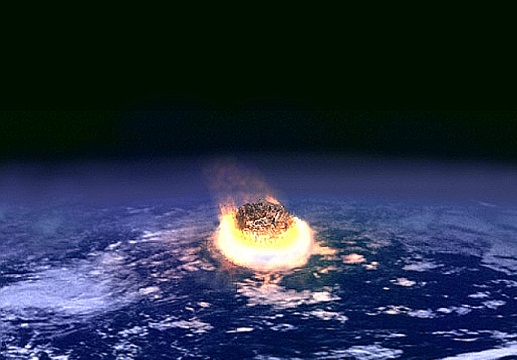
Sometimes those orbits intersect another planet’s orbit. And, the inevitable happens — a collision. That’s true of every world in the solar system. And, of course, that includes Earth. Its orbit intersects orbits of asteroids. Now that we’re getting better at detecting those asteroids, we can predict when such intersections might occur. I say “might” because a given orbit can change over time as the object gets a little gravitational “kick” from nearby worlds. So, if we spot an asteroid today, astronomers plot its path using the discovery and followup observations. If that asteroid’s orbit takes it close to a larger body (such as a planet), it could pick up that gravitational kick, which would alter the orbit slightly.
Asteroids and comets don’t suddenly veer off course, as I’ve read in some breathless prose on the IntarWebs. In particular, they don’t just jump from one orbit into another on their own volition just because they feel like or because some mystical space beam is pushing them along. They have to be physically acted on from another body or force. And, those forces have to be pretty big to overcome the orbital inertia that asteroids and comets have. Nor are nearby spacecraft powerful enough to do it, so that blows the “aliens are sending asteroids toward” us theories out of the water. It takes a big body, like a moon or a planet, or a lot of gravitational force, or a collision with another body to create the nudge that affects an asteroid or comet orbit. Interestingly, in the case of comet nuclei in the outer solar system, a passing star could supply the gravitational nudge to dislodge a nucleus or several, sending them on headlong trips toward the Sun.
The worlds of the solar system are bombarded constantly – make no mistake about that. Earth itself sweeps up incoming debris all the time. Most of it is dust, but sometimes bigger rocks fall from space and hit the ground. This is entirely normal and, unless it’s a HUGE rock, nothing to worry about. And, when a big rock does take aim at us, that, too, will be entirely normal. It’s what happens in solar systems. And, instead of devoting our mental capabilities to making up and believing mystical BS about asteroids and killer x-rays and all that other horse manure that passes for pseudo-science these days, it’s best if we spend time understanding just how the orbits of worlds play a part in these entirely normal and rarely world-shaking events. That’s the nature of science — and science is what opens our eyes to the wonders of the cosmos.
So, here at year’s end, take some time to enjoy the cosmos for what it is — and what it does. Not what somebody imagined it to be in order to scare you or to sell you a book or get you to believe in their cock-eyed theories that don’t stand up to reality. It’s a wonderfully fascinating cosmos.
Note: my old friend Phil Plait (The BadAstronomer) has written a wonderful book called “Death from the Skies” that examines a lot of “end times” scenarios that the cosmos can throw at us — in great scientific detail and a wonderful sense of humor. Check it out!
Been Stargazing Lately?
December 23, 2010 at 11:03 am | Leave a Comment
Looking Up: It’s Worth It, so Give it a Try
The lunar eclipse adventure the other night had a lot of people looking up at the sky. It’s probably safe to say that for many, it was probably the first time ever, or at least the first time in a long time. Granted, the weather this time of year isn’t always conducive to stargazing, particularly so for those of us in the northern hemisphere where cold temps are a constant. But, what’s the excuse of those who aren’t in the cold climates? Too much light pollution? Not safe to go out after dark? If so, that’s sad.
Other reasons are more interesting, like the one I heard from a store clerk the other day: “The night sky scares me.” I asked him why and he said that he likes to look at the stars, but he stays close to the house because it feels like he’ll fall into the sky. That blew me away because I had that same experience once — feeling like I’d fall up into the sky. It happened on Mauna Kea on the Big Island of Hawai’i. I was observing using one of the big telescopes up there, and I stepped outside onto a catwalk that circled the dome. It was absolutely pitch-dark out and the sky was so clear that it really DID look like velvet with diamonds scattered on it. Suddenly I felt like I was about to float up there and out of sight, and I did find myself sort of grabbing for the side of the building. But, it wasn’t scary. Just kind of exhilirating. Still, I did know how the guy felt, in a way.
The night sky isn’t scary, but I imagine our human-reptilian brains are programmed to find dark places somewhat disturbing. And, there is this feeling that you get of being a small thing in a very big cosmos. THAT can also be disconcerting, at first.
However, the night sky is actually rather like a puzzle. You see all these stars up there and, at first, they seem to be randomly scattered across the darkness. Then, after a while, you start to see patterns in the star distribution. Shapes leap out at you, and before you know it, you’re recognizing the Big Dipper, Orion, the northern or southern cross, and other well-known shapes. It’s rewarding and visually links you with the universe you’re a part of. No matter where you are.
So, give it a try. Here’s a star map that I sent out with my holiday cards this year. It’s northern-hemisphere oriented, but Orion is visible fairly far south, as are most of the other labeled objects. It’s set for December 25, around 9:30 p.m., but will be good for a few days before and after that date, so give it a try.
Eclipse Success!
December 21, 2010 at 2:30 am | 2 Comments
Well, That Will Teach Me
Amazingly enough, the sky cleared up enough for us to see the eclipse from our deck. That will teach me to post a gloomy note about how we probably weren’t going to see the lunar eclipse! In fact, it cleared up so nicely that we had a starry sky for quite a while during totality. Quite a contrast to the snowy, rainy and cloudy day we experienced.
As I write this, the clouds are starting to move in and totality has ended. But, here are four of the best images we took during the event. And now… time to get some sleep! Great eclipse, gorgeous red color and… best of all… we got to see it! Win-win all the way around!

First shot, before totality. Copyright 2010, Mark C. Petersen

Second shot, right before totality. Copyright 2010 Mark C. Petersen

During totality. Copyright 2010 Mark C. Petersen.

The eclipsed Moon at totality, with a starry backdrop. Copyright 2010 Mark C. Petersen.

After totality, the Moon coming out of Earth's shadow. Copyright 2010, Mark C. Petersen.
Older entries »
This blog a wholly pwnd subsidiary of Carolyn Collins Petersen, a.k.a. TheSpacewriter.
Copyright 2013, Carolyn Collins Petersen
Inama Nushif!
Image of Horsehead Nebula: T.A.Rector (NOAO/AURA/NSF) and Hubble Heritage Team (STScI/AURA/NASA)
“It is by Coffee alone I set my day in motion. It is by the juice of bean that coffee acquires depth, the tongue acquires taste, the taste awakens the body. It is by Coffee alone I set my day in motion.”
Spam prevention powered by Akismet


