These pages chronicle the work and ruminations of Carolyn Collins Petersen, also known as TheSpacewriter.
I am CEO of Loch Ness Productions. I am also a producer for Astrocast.TV, an online magazine about astronomy and space science.
For the past few years, I've also been a voice actor, appearing in a variety of productions. You can see and hear samples of my work by clicking on the "Voice-Overs, Videos and 'Casts tab.
My blog, TheSpacewriter's Ramblings, is about astronomy, space science, and other sciences.
Ideas and opinions expressed here do not represent those of my employer or of any other organization to which I am affiliated. They're mine.
Visit my main site at: TheSpacewriter.com.
**Comments are welcome; I do moderate them to weed out spam.
Contact me for writing and voice-over projects at: cc(dot)petersen(at)gmail(dot)com
I Twitter as Spacewriter
Blog entry posting times are U.S. Mountain Time (GMT-6:00) All postings Copyright 2003-2011 C.C. Petersen
Spacewriter’s Recent Posts
- A UFO? A Plane? What is It?
- Planet Viewing
- Double Your Viewing
- Super Moon? Super What?
- Sic Venus Transit Solis
- Hurray, Hurray, the First of May
- Dwarfs in the Cosmos
Archives
- ► 2012 (28)
- ► 2011 (107)
- ► 2010 (95)
- ► 2009 (225)
- ► 2008 (291)
- ► 2007 (114)
- ► 2006 (72)
- ► 2005 (56)
- ► 2004 (96)
- ► 2003 (74)
- ► 2002 (21)
Calendar
| S | M | T | W | T | F | S |
|---|---|---|---|---|---|---|
| « Nov | Jan » | |||||
| 1 | 2 | 3 | 4 | |||
| 5 | 6 | 7 | 8 | 9 | 10 | 11 |
| 12 | 13 | 14 | 15 | 16 | 17 | 18 |
| 19 | 20 | 21 | 22 | 23 | 24 | 25 |
| 26 | 27 | 28 | 29 | 30 | 31 | |
Like space music?
Check out my favorite
space music artist:
Geodesium
at Geodesium.com
Blogroll
- 21st Century Waves - Technology Booms and Human Expansion Into the Cosmos
- About.Com Space/Astronomy
- Adot’s NotBlog
- Astroengine.com
- Astronomy Blog
- Astronomy Cast
- Badastronomy.Com
- Blooloop
- BLooloop: CCP
- Captain Disillusion
- ChandraBlog - Chandra X-ray Telescope
- Cosmic Log
- Cosmic Mirror
- Cosmic Variance
- Cosmos4u
- Discovery Space
- DP’s Astronomy Blog
- EurekAlert
- European Southern Observatory
- Friends of the Griffith Observatory
- Gemini Observatory
- Griffith Observatory
- Hairy Museum of Natural History
- Hubble Space Telescope
- Kids Directory
- Loch Ness Productions - Cosmic content
- Mike Brown’s Planets
- MIT/Haystack Observatory
- MWA Vodcast
- NASA Climate Change
- National Public Radio
- Observing the Sky
- One Astronomer’s Noise
- Pharyngula
- Prince of Pithy
- Science Made Cool
- Significant Snail
- Solar System Watch
- Space Times News
- Space Weather FX Vodcasts
- Star Stryder
- Stop Unethical Recission
- String Theory
- The Daily Galaxy
- The Mathroom (possibly NSFW)
- The Meridiani Journal
- The Planetary Society Blog
- The Way Things Break
- TheCrotchetyoldfan
- Truth
- Understanding Science
- Universe Today
We Need More Cloud-Be-Gone Over Here!
December 20, 2010 at 11:26 am | Leave a Comment
Hit or Miss on the Lunar Eclipse

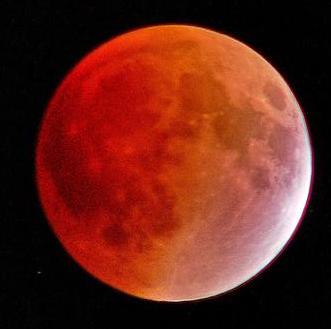
How tonight/tomorrow morning's eclipse will look near totality -- for those lucky enough to have NO cloud cover! Courtesy Steev in Wollongong, Australia, supplied by Wikimedia Commons.
You may have heard there’s a spectacular lunar eclipse starting late tonight and going in to early tomorrow morning, visible to those of us in North and Central America. It coincides with the winter solstice (Dec. 21), which is a rarity in itself. And, by all accounts, it should be a great viewing spectacle. Of course, you need clear skies to see the lunar eclipse, and in my neck of the woods (western U.S.), that’s going to be a tough one. We’re clouded over and probably will get rain or snow through the night. Still, hope springs eternal, and I will stay up and see if any sucker holes open up that will allow me to see the events as they unfold high overhead.
That’s the nature of observational astronomy from the surface of Earth: you’re at the mercy of the elements. That hasn’t stopped any of us from going out and trying to see sky phenomena, despite the weather forecast. It didn’t stop William Herschel, who made some of his most far-reaching discoveries from under the often-cloudy skies of Ireland and England. I often take inspiration from him and his sister Caroline. They persevered despite the conditions they had to work under. And, I can always hope that maybe the weather forecast won’t play out the way the meterologists have been predicting. That’s the nature of weather… predictable and changeable, both at once. If you’re going to be an astronomer, weather is something you’ll be very familiar with as you do your stargazing. Last month, we battled some pretty cold weather in Iceland to see (and film) the northern lights. It was cold, but worth the effort for the eerie experience of watching the auroral dance.
So, take heart: if you have clear skies and live in North America or Central America, step out tonight and early tomorrow and check out the Moon. It’ll be a lovely sight. For more information on the eclipse and when/where to look, check out Sky and Telescope’s Web site.

Space for the Holidays
December 19, 2010 at 16:48 pm | Leave a Comment
Giving the Gift of Astronomy
We went shopping the other day. This is the season for prolongued bouts of buying stuff for our loved ones, friends, bosses, whoevers, and of course, you can find all kinds of gew-gaws out there to give. Mr. Spacewriter and I were looking for specific objects, and we did find a few things, but not quite what we were looking for. Still, it was interesting to browse the aisles of some stores and see what the marketing types thought we should be giving to others: electronic book readers, the latest phones, computers, perfumes, clothes, and even household things like vacuum cleaners. Not knocking those things — I’m sure that somebody’s baby out there wants one of those objects and whoever gets it for them will be a hero, at least for the holidays.
If you’ve been out there bulling your way through the maddening crowds and haven’t found something that quite matches for someone you want to impress/love/woo/etc., why not consider giving an astronomy- or space-related gift? I’ve got a few suggestions here that might help you out of what could be a tough gift bind. (Or, maybe you want to treat yourself to something spacey…)
First, I am a member of Friends of the Observatory, the support group for Griffith Observatory in Los Angeles, California. You can be, too, and you don’t even have to live there. I don’t live in SoCal, but I do find myself working/visiting/doing business out there throughout the year, and a trip to Griffith is always one of my stops. FOTO, as it’s lovingly called, does a lot of good things for the observatory — which is one of the most popular public observatories in the world. Among other things, FOTO gathers the funds to bring students from the Los Angeles Unified School District on fifth-grade school field trips. This is a trip that, without funding, many school kids would never get to experience, and I support anything that brings the science of astronomy to kids in a meaningful way. You can join for as little as $45.00, which gets you a number of great benefits, including a one-year subscription to the world-famous Griffith Observer. I’ve been supporting Griffith for a number of years now through FOTO, and even though I don’t live there, I find it to be a wonderfully rewarding investment. So might you. Check out FOTO at the link above. (For the record, I also wrote all of Griffith Observatory’s exhibits — so, if you go there, check out the words on the walls… I guarantee, you’ll learn some astronomy!)
I’m also a member of the Astronomical Society of the Pacific, an astronomical organization that works to increase the understanding and appreciation of astronomy by everyone, using scientists, educators, enthusiasts, and the public to advance science and science literacy. I have been working with this group for a couple of years now on a project called “Astronomy Behind the Headlines” — a series of podcasts that’ll bring you in contact with scientists at the cutting edge of astronomy. ASP is a godsend for teachers and outreach specialists, as well as folks who are just plain curious about the universe. GO check out their Web page and see if a membership or donation to ASP is a fit with your gifting goals.
As many of my long-time readers know, I love books. I’ve written a couple about astronomy and space science, and I like to read astro books, too. Just in time for the holidays a couple of really neat ones have landed on my desk and you might like them, too.
The first is called “Postcards from Mars” — written by Dr. Jim Bell, astronomer and planetary scientist at Cornell University in New York, and published by Plume Books. Jim was in charge of the photography teams on the Spirit and Opportunity missions that are still sending back images from Mars. For this book, which is gorgeous, he spent hundreds of hours selecting images from the rovers, cropping and processing them, and aseembling them into a book that tells the tale of the rovers from launch to the continuous stream of image deliveries they’ve made during their mission lifetimes. I really enjoyed this book — twice. First, I simply leafed through it, admiring all the wonderful images. Then, I read through it, appreciating the story of two missions as told by one of the mission scientists who put these images in front of us. It’s really a great find and if you have a Mars lover on your gift list (or if you are one), then this is a great find. I know I loved looking through it — but then again, I’m an old Mars fanatic from way back. You can’t beat postcards from another planet as a way to impress your giftee!
The other book that found its way onto my reading list is called Sizing up the Universe: a New View of the Cosmos and published by National Geographic. Anyone who studies astronomy is instantly engulfed by the scales of objects we explore. From the sizes of planets to the limits of the observable universe, the scale of the cosmos can sometimes be more than we can easily comprehend. That’s where this book comes in — it seeks to help you understand just how big things are and how far away they are — in terms that won’t completely boggle your mind. It uses scaled maps and comparisons of objects at different scales, by way of gorgeous illustrations, to help readers understand size comparisons in the universe. It presents the vast distances of the cosmos in a very beautiful and graphical way — including an instantly understandable Gott-Juric Map of the Universe in Chapter 4 that has been reprinted as a foldout map. The authors, Princeton professors J. Richard Gott and Robert J. Vanderbei, write in a very clear and approachable way and their explanations of distances and sizes by analogy are very good. For example, there’s a set of beautiful images in a section called “Exoplanets Compared” that shows some of the known exoplanets overlying their parent stars, and with solar system planets overlaid in comparison. You instantly “get” the size of these worlds and their stars. The book is a treasury of these kinds of comparisons. There’s a lot more, which makes this book a great gift for that person in your life who is curious about what’s “out there,” how big it is, and how far away it is.
In closing, I have to admit that I do really enjoy reading actual books. I’ve been pondering getting a Kindle or a Sony reader or something, and I actually played with one the other day. But, you know… it just doesn’t hold a candle (or Kindle) to turning the pages and basking in the loveliness of a book on a lazy afternoon… and, I wonder just how well an astronomy book like these two would work out on the readers. And, of course, NO reader is going to give you the same experience as visiting a place like Griffith or belonging to a group like ASP… they’re all worthy experiences, requiring different applications of your personal attention.
Happy Space Gifting!
Arsenic-Eating Life and New Planets
December 2, 2010 at 13:58 pm | 3 Comments
Scientists Study Places Where Life Thrives…
and where it May Someday Exist
Judging by the uproar over the past few days in the blog-o-sphere and comment-o-sphere, you’d think that NASA was announcing that life had been discovered on Mars or Titan or any number of other unlikely places. What I’ve seen in idle speculation and comments on blogs, FaceBook, and even on some news sites, leads me to wonder if there’s any intelligent life left on the Web. I mean, come on. There’s been some pretty irresponsible commentary by all kinds of people (including journalists, bloggers, and some scientists) and it’s really taking away from the wonderfulness of the actual discoveries. Well, let’s take a look at the REAL stories and see what all the fuss is about.
The first, being talked about today, is the finding that some bacteria that live in Mono Lake in California appear to eat and apparently thrive on arsenic — a chemical that is usually toxic to life. This finding is based on laboratory studies of these bacteria. In such a setting, not only can these buggers eat the stuff, but they appear to have evolved enough to be able to chemically alter it and incorporate it into their DNA. The lead researcher, Dr. Felisa Wolfe-Simon at the U.S. Geological Survey, put it pretty well: “”We know that some microbes can breathe arsenic, but what we’ve found is a microbe doing something new — building parts of itself out of arsenic,” she said. “If something here on Earth can do something so unexpected, what else can life do that we haven’t seen yet?”
Bugs eating arsenic? That result is going to have a huge impact on other areas of research into life and its processes, including the study of Earth’s evolution, organic chemistry, biogeochemical cycles, disease mitigation and Earth system research. To put it simply, this has implications for understanding the chemical environments that life can exist and thrive in. Essentially, this NASA-funded research is changing our very basic knowledge about what kinds of life forms we have on this planet, and where they can exist and thrive.
Now, this is a far cry from breathless claims that NASA was going to announce life on Mars and all the other shouting that we’ve been seeing on the Web and in the press the past couple of days. Those are the usual claims, and I find them wearisome when they come without any proof or understanding of the actual science being reported.
On the other hand, this report is REAL science being shared by real scientists who have been out the field doing what science does best: examining, studying, and understanding what’s right in front of us. It’s exciting. It’s different. And, it’s going to spur other scientists to study the results and extend them into other areas. But it’s not little green life forms holding up their middle fingers and saying, “Take me to your arsenic.” Quite the opposite: the little life forms seem to have found their arsenic and said, “We’re happy here, thank you very much.”
You can also read more about this fascinating biological discovery at Science’s web site, the journal that is publishing the story of the arsenic-loving critters.
The second discovery this week that has implications for life is the revelation by astronomers using the Very Large Telescope in Chile of a super-Earth exoplanet (i.e. a semi-Earthlike planet bigger than Earth) that has what appears to be a water-rich atmosphere. This water could be in the form of steam, or wet clouds or hazes. GJ 1214b has a radius of about 2.6 times that of the Earth and is about 6.5 times as massive. Its host star is a small faint star about 40 light-years from Earth in the constellation of Ophiuchus. You can read more details here.
Of course, as soon as news of this discovery came out, I began to see speculation about life being discovered on that planet. Not just in news sites, but all around the web-o-sphere and by commentators who should have known better. I hate to be a wet blanket (so to speak), but the presence of water does NOT equal the presence of life. It DOES mean, however, that the environment on that planet could be conducive to the formation of life that depends on water. And, that’s pretty darned cool. Still, no actual discovery of life has happened there… yet.
I think that this tells us, more than ever, that the conditions for life do exist “out there” and that the formation of planets where life could form and exist is not limited to our own solar system. It’s not surprising to find these planets — eventually we were bound to. Coupled with the astrobiology discovery announced today, it tells ME that this universe is complex, fascinating, and always ready to hand us a surprise or two!
« Newest entries — Older entries »
This blog a wholly pwnd subsidiary of Carolyn Collins Petersen, a.k.a. TheSpacewriter.
Copyright 2008, Carolyn Collins Petersen
Inama Nushif!
Image of Horsehead Nebula: T.A.Rector (NOAO/AURA/NSF) and Hubble Heritage Team (STScI/AURA/NASA)
“It is by Coffee alone I set my day in motion. It is by the juice of bean that coffee acquires depth, the tongue acquires taste, the taste awakens the body. It is by Coffee alone I set my day in motion.”
Spam prevention powered by Akismet