
It Survives Bombardments
Our planet is young, in cosmic time. And life on our planet is just about as young.
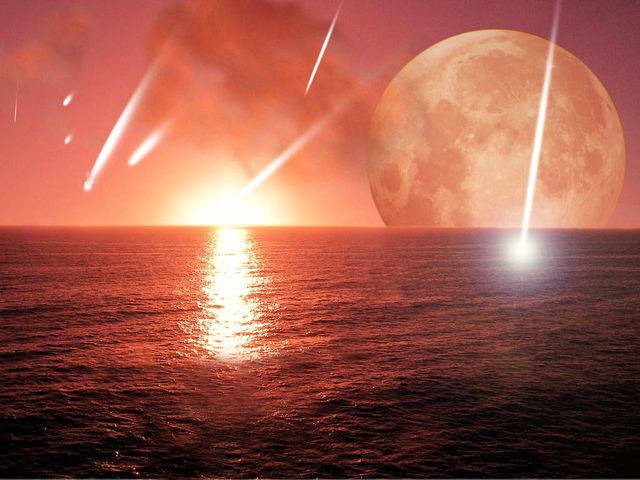
The universe is some 13.7 billion years old. A lot of time had to pass — say, nine of so billion years — before the Earth began forming, some 4.5 billion years ago. The place was nothing like the planet we know today. It had just accreted from “stuff” in the proto-solar nebula. The baby Earth was hot, but cooling down. It had some kind of atmosphere, although nothing we could breathe. And, it was being hammered by leftover debris from the rest of the solar nebula. The period it was experiencing is called the Late Heavy Bombardment, and it was long thought that the bombardment would have sterilized the surface of the planet (if any life had managed to arise there).
It turns out that the picture of a spanking clean new planet with NO life on the surface during and after the bombardment may need to be rejiggered a bit. A study funded by NASA indicates that the Late Heavy Bombardment may not have sterilized the early Earth as completely as scientists thought, and that some of the incoming asteroids (some the size of Kansas) might have actually boosted the chances for life.
The study focused the Late Heavy Bombardment, which occurred approximately 3.9 billion years ago. It pummeled the planet anywhere from 20 to 200 million years. In a letter published in the May 21 issue of Nature magazine titled “Microbial Habitability of the Hadean Earth during the Late Heavy Bombardment,” Oleg Abramov and Stephen J. Mojzsis, astrobiologists at the University of Colorado’s Department of Geological Sciences, described a computer modeling project they designed to study how the bombardment heated Earth. They ran simulations of the bombardment and the results show that while the Late Heavy Bombardment might have generated enough heat to sterilize Earth’s surface, it probably didn’t do much damage to microbial life in subsurface and underwater environments. In fact, those little critters almost certainly would have survived the bombardment without much trouble.
The story of life on this planet is a tough one to tell. For one thing, it’s not easy to say exactly when life arose. Scientists are getting closer to pinpointing its time, but we may never know exactly where it got the first “oomph” that transformed some randomly mixing chemicals into a living thing.
The sort of “canonical” start date that we toss around is usually 3.8 or 3.9 billion years ago, but it could well have been earlier. These findings are significant because they indicate that if life had begun before the LHB or even earlier than 4 billion years ago, it could have survived in those hidden places protected by the surface from the bombardment. Certainly all the elements for life were in place by the time the planet finished forming — carried in by asteroids and comets, and in place from the elements from which the planet formed.
Astrobiologists are examining each step in the ladder of life minutely — from the elements that formed this planet to the processes taking place on and near Earth during the crucial time when life arose. What they learn may well translate to the stars, especially when we start looking at other planets where life may have arisen.