I suppose it’s fitting that during the week of major discoveries on cold, methane/ethane-slushy Titan that a snowstorm would arrive to remind us of winter cold here on Earth. However, what some of us are experiencing in the snowstorm currently enveloping the New England area of the U.S. would be a balmy day on Mars and a downright searing heat wave on Titan! Imagine the report from The Weather Channel(tm) if we lived on Titan:
Folks out near Dragon’s Head are well advised to stay inside for the rest of the day, as a strong cold front is bringing methane flurries. Temperatures could plunge to -183 Celsius, with wind chills making it feel like -190. Watch out for lake-effect accumulations around the shores of Snowy Sea. And people, if you don’t have to be out, we advise you stay in and stay warm!
It’s kinda fun to think about “extreme” weather on other planets and how we’d deal with it if we lived there. Of course, life on Titan (for humans) would be a challenge of major proportions. Just how would we build habitats? Out of what? And why would anybody want to live there? There’s another good science fiction story there, just waiting to be written!
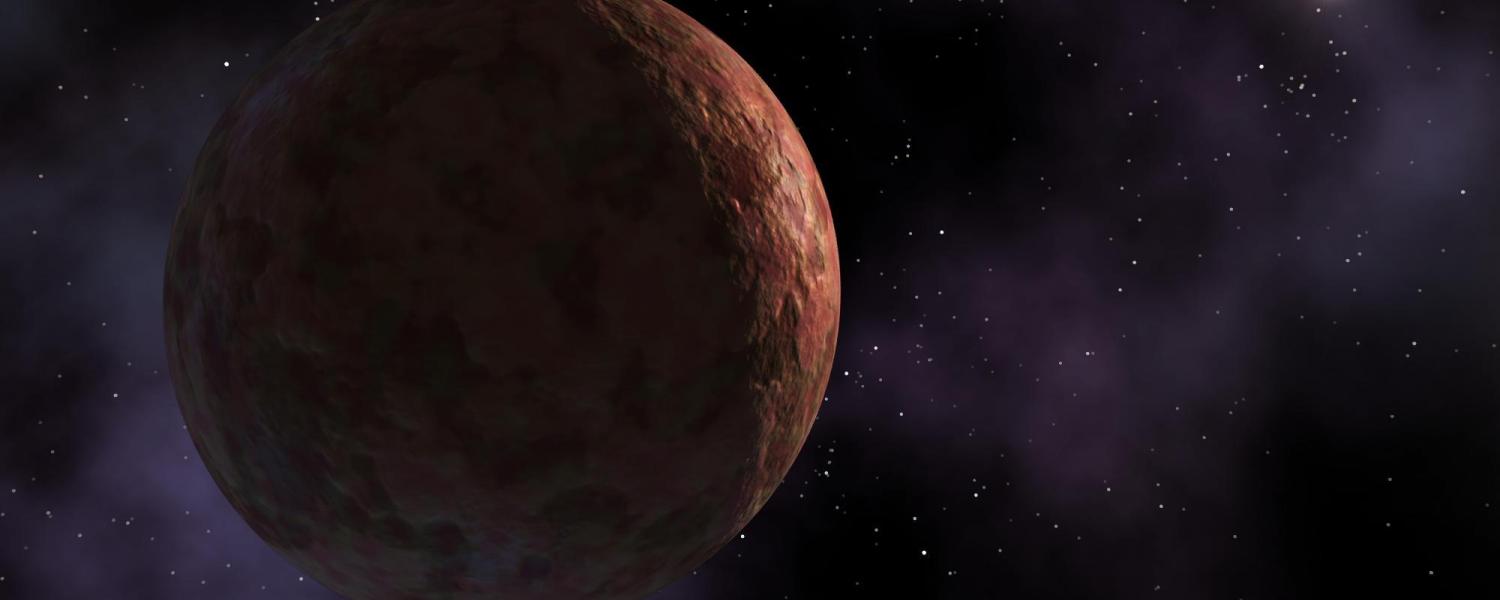
An artist’s conception of Sedna, a dwarf planet in the Kuiper Belt. Credit: NASA/JPL-Caltech
Remember a year or so back when the largest Kuiper Belt Object to date, named Sedna, was discovered? It shifted planetary scientists’ attention to the origin and evolution (and existence!) of large, planetoid-sized objects out beyond Pluto. They’ve been working out the fine details of Sedna’s orbit for a while now, using sophisticated models of the early solar system formation. One of the outcomes of this work is the idea that this nearly-Pluto-sized “worldlet” actually formed in place in the frigid deep-freeze of the outermost solar system. Originally scientists thought it was assembled farther in toward the Sun during the early days of the system’s formation, and was somehow ejected out to its current position.
Why does where Sedna formed matter? Astronomers have longed assumed that planetary formation took place in a rather smaller region of the original solar nebula. If Sedna was created from the collisions of smaller bodies out in the “sticks” of the solar system, then the planetary factory is bigger than everybody suspected. It also means that the Kuiper Belt, which hosts countless bodies at what used to be called “the edge of the solar system” is really part of a larger region called the Kuiper disk and played a much more prominent role in the formation of planets and moons.
The modeling that led to these conclusions was done at the Southwest Research Institute in Boulder, Colorado. In the press release they sent out announcing this work, the institute’s Executive Director for Space Studies, Alan Stern (a former colleague of mine from the University of Colorado), talked about some of the assumptions they made in constructing their model: “”The Sedna formation simulations assumed that the primordial solar nebula was a disk about the size of those observed around many nearby middle-aged stars — like the well-known example of the 1,500-AU-wide disk around the star Beta Pictoris.”
It’s interesting work because it gives us a whole lot MORE insight into the infancy of our own solar system, in particular the formation of planets from smaller planetesimals. And, chances are if Sedna formed where the astronomers think it did, then there could well be more large planetoids circling around out there with it — and that what we used to think of as the “emptiness of the outer solar system” isn’t so empty anymore. As astronomers learn more about the Sun’s outermost retinue of planetesimals, they are finding more clues to what conditions were like early in the history of solar system.