
Back to the Future with 2001

It Holds Up Well

Last week I was in Iceland, doing a series of lectures for a touring group. We had a fabby time touring the glaciers, hiking, checking out the glaciers, and waiting for the northern lights to appear. Since it was my second visit, I was able to look at the country with a fresh set of eyes. It’s a gorgeous place and, if you’re into planetary science, it’s where you go to learn about how our planet forms and evolves.

Speaking of looking at things with new eyes, I had a chance to watch 2001: A Space Odyssey while flying back home.  I haven’t watched that movie in decades, so it was a lot like watching it for the first time. My very first viewing was when it first came out. I went to see it with my dad and I remember we came out of the theater with glazed looks on our faces. We talked about it for a long time afterwards, once we were able to put our thoughts into words.

Seeing Through Different Eyes

This time, I was seeing 2001 with a producer’s eyes. Also, since I’ve read the SF work it was based on, I had a more experienced view of Sir Arthur Clarke’s work. I must admit, the movie holds up well on both counts. Its visualizations are pretty decent, considering it was made long before all the fancy CG programs we have access to now. I found the storyline to be as interesting as I did before. The movie plays it out with quiet grace and elegance. I didn’t notice the first time around, but this time (as a scriptwriter) I noticed just how banal the dialogue is. There are just enough lines to advance the story, but some of them are very trite. I suspect that was intentional. They wanted to show that our human concerns look pretty small when played out against the backdrop of the universe.

If you get a chance, go watch 2001. For folks who were much too young to see it the first time (or weren’t even born), it may move slowly. That’s okay. It’s not an action-adventure flick. It’s a thoughtful look at our place in the cosmos through the ages. It’s th e first film that I remember in the “space” genre that took the story seriously. That’s not to say Star Wars and Star Trek and others aren’t serious. They’re just different. So, check it out. Well worth seeing!

Rosetta’s Last Hurrah at Comet 67P

Rosetta Becomes One With Comet 67P

rosetta comet landing
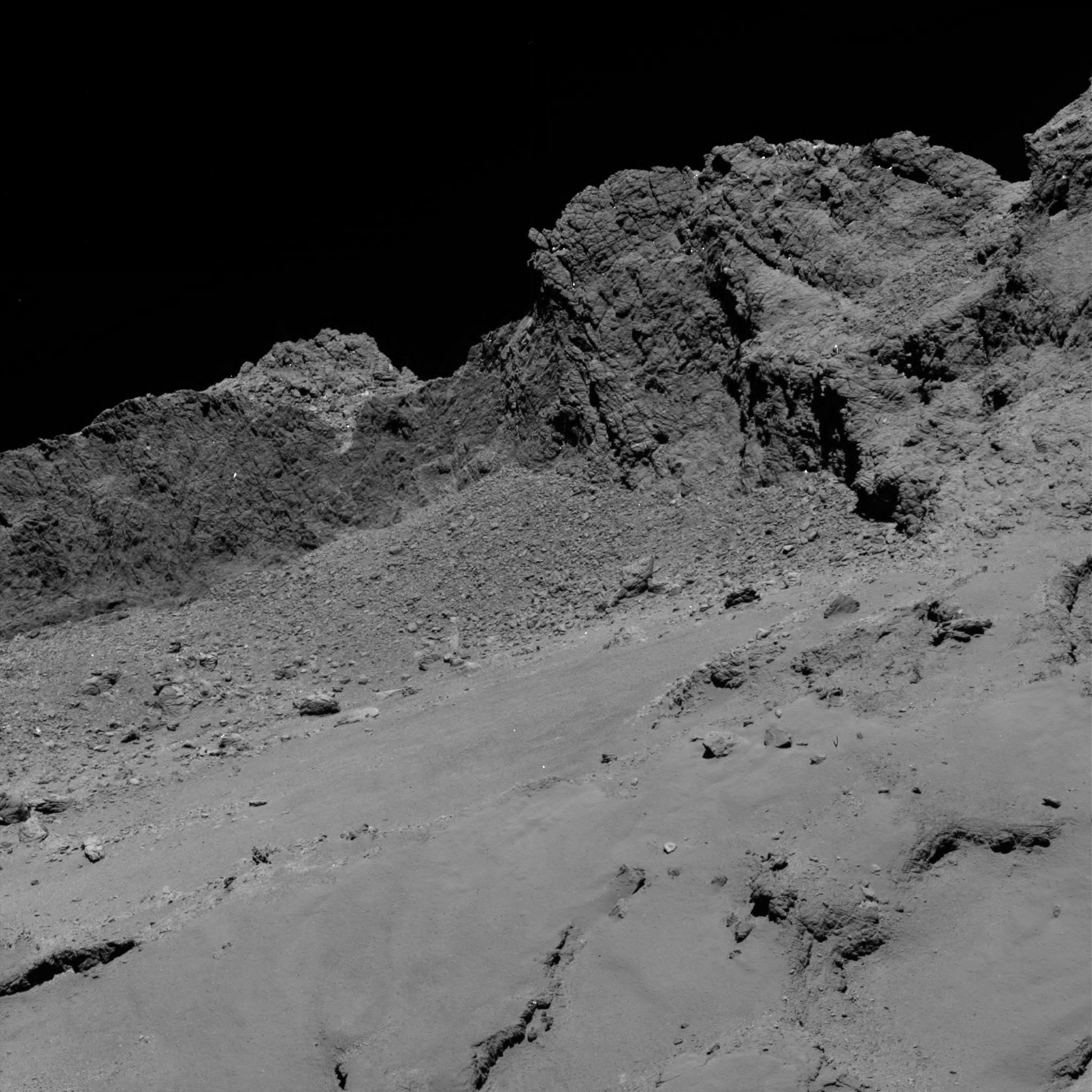
One of the last images taken by the Rosetta orbiter on its way to the surface of Comet 67P/Churyumov-Gerasimenko. Courtesy ESA.

On September 29th, 2016,  ESA’s Rosetta orbiter made a guided “soft” crash landing onto the nucleus of Comet 67P. It’s now forever a part of the comet. It will be until the nucleus breaks up sometime in the future as it rounds the Sun. By all accounts (and you can read detailed reports on the mission at the Rosetta site), the mission was a rousing success. It was the first one to do a long-term orbit of a comet and send back stunning high-res images of the nucleus. That alone cemented its place in history for me. Back in grad school I studied comets and always wondered what it would be like to land on a nucleus. With Rosetta, that wonder was satisfied.

Exploring Small Worlds

Rosetta isn’t the first and won’t be the last to study such fascinating world. I feel pretty confident that there will be more probes to asteroids and comets. These objects are the building blocks of the solar system. These families of small bodies were the first to clump together to form the planets. That means they hold the key to understanding what materials and conditions were like as the solar system formed some 4.6 billion years ago. They may even hold clues to primordial materials that existed even before the Sun and planets began their birth process. For those reasons and many others, I hope we do continue to study these worldlets.

What’s Next For the Rosetta Mission?

The scientists on the Rosetta mission literally have many years worth of study ahead of them. The spacecraft sent back tantalizing data about the ices and dust in the comet, its lack of magnetic field, and other characteristics. I imagine that many post-docs and PhD students will contribute their brainpower to understanding the data and communicating what they find to the rest of us. So, far from being over, the Rosetta spacecraft’s greatest legacy is just beginning: analyzing and comprehending what the spacecraft “saw” for the rest of us.

Exploring Science and the Cosmos

Spam prevention powered by Akismet