
So Far
Well, another year has come and gone and Earth hasn’t been blasted apart by rogue asteroids, visited by aliens, irradiated by killer space beams from the center of the galaxy, or any of a bunch of other pseudo-scientific “death from the cosmos” scenarios that get floated around the IntarWebs every year. I don’t know about you, but I’m relieved. Of course, it’ll all start up again (does the ignorant rumor-mongering ever quit?) in the New Year. I’ve already been getting a few spam mails from people trying to convince everybody that the year 2012 is the End of Time As We Know It, as supposedly predicted by the Maya people, the flying saucer people, the Greys, the Pleiadians, the Trilateral Commission, the Planet X/Nibiru/N*ncy-Bot people, and all kinds of other folks who seem to take endless delight in making up stuff out of nothing and then using it to scare people/sell stuff/get attention. Chances are you’ve read about their “predictions” from time to time, and hopefully you’ve laughed at their endless prattling in blogs (complete with CAPITAL LETTERS AND LOTS OF !!! AND ??? and silly comments like “No one has ever seen this before” and “NASA is baffled” and “the truth the government doesn’t want you to know about aliens” and other such horse manure).
Now, just because these paranoid shills are making stuff up about the cosmos doesn’t mean that the cosmos is a benign place. Quite the contrary. For example, there ARE asteroids out there. Thousands of them. Most of them are in the Asteroid Belt and are quite likely to stay there, happily orbiting the Sun until the end of time. But, there are other asteroids on their own orbits, some of them quite close to the Sun and which could pose a danger to any of the planets whose orbits they intersection (and not just Earth).
Since its formation some 4.5 billion years ago, Earth and all the other planets, have been bombarded by asteroids and comets. That’s the nature of life in the solar system. If you look at it from a systems evolution standpoint, it’s completely obvious that planets are going to get smacked at some point in their histories. It’s not terribly different from putting a bunch of race cars in a racing oval and letting them go. The race evolves from a bunch of cars in their own lanes to cars that might collide, which then causes other collisions, and eventually you could have cars smashed together into bigger balls of debris.
The early solar system was not made of cars, but it was full of debris circling in orbit around the newborn Sun. Those chunks of ice and rock ran into each other, or were gravitationally attracted to each other. As planets coalesced from that debris, they collided with the leftovers as they, too, orbited the Sun. Earth and all the other planets have pretty much swept their own orbits relatively clean of debris. But, there’s still a lot of debris left over, and each of those pieces (the comets and asteroids) are on their OWN orbits.
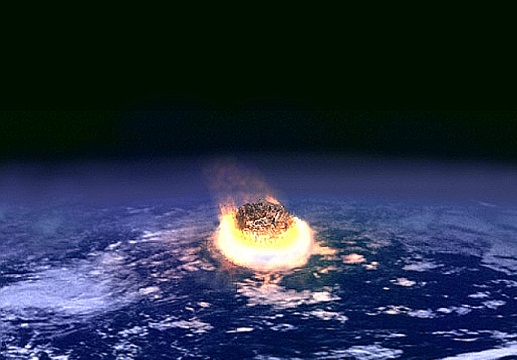
Sometimes those orbits intersect another planet’s orbit. And, the inevitable happens — a collision. That’s true of every world in the solar system. And, of course, that includes Earth. Its orbit intersects orbits of asteroids. Now that we’re getting better at detecting those asteroids, we can predict when such intersections might occur. I say “might” because a given orbit can change over time as the object gets a little gravitational “kick” from nearby worlds. So, if we spot an asteroid today, astronomers plot its path using the discovery and followup observations. If that asteroid’s orbit takes it close to a larger body (such as a planet), it could pick up that gravitational kick, which would alter the orbit slightly.
Asteroids and comets don’t suddenly veer off course, as I’ve read in some breathless prose on the IntarWebs. In particular, they don’t just jump from one orbit into another on their own volition just because they feel like or because some mystical space beam is pushing them along. They have to be physically acted on from another body or force. And, those forces have to be pretty big to overcome the orbital inertia that asteroids and comets have. Nor are nearby spacecraft powerful enough to do it, so that blows the “aliens are sending asteroids toward” us theories out of the water. It takes a big body, like a moon or a planet, or a lot of gravitational force, or a collision with another body to create the nudge that affects an asteroid or comet orbit. Interestingly, in the case of comet nuclei in the outer solar system, a passing star could supply the gravitational nudge to dislodge a nucleus or several, sending them on headlong trips toward the Sun.
The worlds of the solar system are bombarded constantly – make no mistake about that. Earth itself sweeps up incoming debris all the time. Most of it is dust, but sometimes bigger rocks fall from space and hit the ground. This is entirely normal and, unless it’s a HUGE rock, nothing to worry about. And, when a big rock does take aim at us, that, too, will be entirely normal. It’s what happens in solar systems. And, instead of devoting our mental capabilities to making up and believing mystical BS about asteroids and killer x-rays and all that other horse manure that passes for pseudo-science these days, it’s best if we spend time understanding just how the orbits of worlds play a part in these entirely normal and rarely world-shaking events. That’s the nature of science — and science is what opens our eyes to the wonders of the cosmos.
So, here at year’s end, take some time to enjoy the cosmos for what it is — and what it does. Not what somebody imagined it to be in order to scare you or to sell you a book or get you to believe in their cock-eyed theories that don’t stand up to reality. It’s a wonderfully fascinating cosmos.
Note: my old friend Phil Plait (The BadAstronomer) has written a wonderful book called “Death from the Skies” that examines a lot of “end times” scenarios that the cosmos can throw at us — in great scientific detail and a wonderful sense of humor. Check it out!