
What are You Lookin’ At?

Stargazing Much?

Yes, I know it’s winter for those of us in the northern hemisphere, although the wintry weather should start giving way to the warmer stuff in a few weeks.  We had a taste of it this past weekend out here in the sticks where I live. The sky was clear and the Moon has been gorgeous.
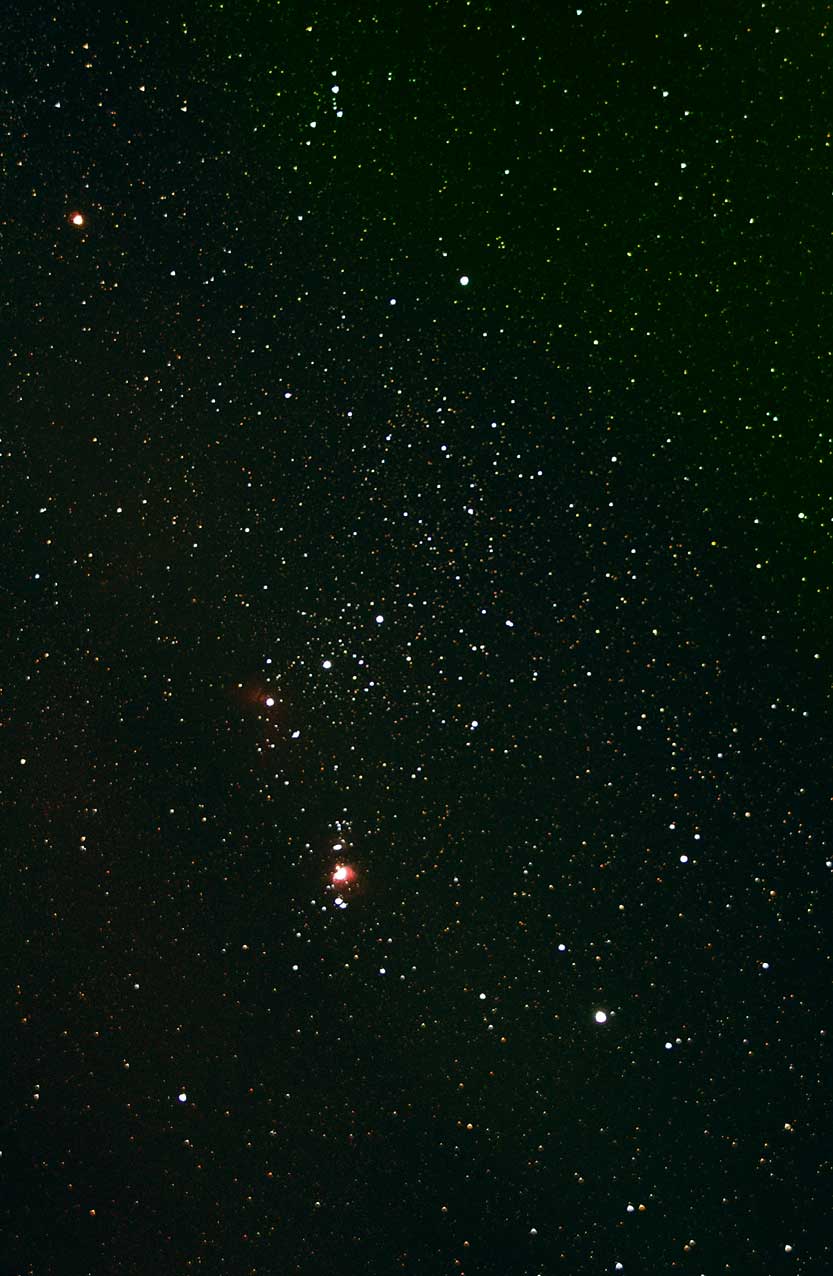
Orion, courtesy Richard Drumm, the Astronomy Bum. (Click to enlargenate.)

This is the time of year when the winter constellations are starting to slip lower in the west earlier each evening. Orion’s still holding up his part of the sky — so, if you want to see a starbirth region and several bright stars, go check out the Mighty Hunter while he’s still available.

The starbirth region is the Orion Nebula (also called M42), and it’s the faint fuzzy patch located below the three Belt Stars in the center of the constellation. There are hundreds of young stars shining out in the Nebula, including the four brightest which are collectively called the Trapezium (the reddish blob in the image at left). They are relative newborn stars, still eating away at the cocoon of gas and dust that gave them birth.

A star map showing the constellation Orion and associated objects and stars. (Courtesy Wikimedia)
A star map showing the constellation Orion and associated objects and stars. (Courtesy Wikimedia--click to biggify.)

Astronomers have been studying the Orion Nebula in great detail, and have also found brown dwarfs and possible planetary systems in the region. What we can see easily through smaller telescopes and binoculars is part of a larger complex called the Orion Molecular Cloud, which contains a number of other objects you can see with medium-to-large telescopes. These would be the Flame Nebula, Barnard’s Loop, and the Horsehead Nebula. So, give that one a look, if you can, if for no other reason than the exotically named objects you can observe.

The bright stars are Betelgeuse and Rigel. Although not part of Orion (and not seen in this picture), you can’t miss Sirius (the three Belt Stars point right to it).  Sirius is the brightest star in the sky and is actually a binary star that’s really a white dwarf.  At 8.7 light-years distance, Sirius is one of the Sun’s closer neighbors.

Orion’s a good start for stargazing these chilly nights (and yes, it can get chilly even in warm climates), so go check it out. Bring along the binoculars if you can. And, if the Moon is bright, check it out AFTER you look at other parts of the sky (otherwise if you look at it first, you blow your dark adaptation).

Enjoy!

Lulin Along

Comet Studies, Redux

Comet Lulin (C/2007 N3) as imaged by Rolando Ligustri (http://www.castfvg.it/)
Comet Lulin (C/2007 N3) as imaged by Rolando Ligustri at http://www.castfvg.it/ The lower image shows the comet's plasma tail disconnecting. (Click to embiggenate.)

Wow — the images of Comet Lulin are simply amazing. I’ve been following its progression in amateur images for the past week or two and it’s like being back in school back when I used to study comet disconnection events in exchange for grad student tuition.

Why do I say that?  Well, when I went back to school in 1988 with the intent of amassing enough cred to try for a Ph.D in astrophysics (which I didn’t get, but got something else instead, it’s a long story), one of my first jobs was to study images of Comet Halley. LOTS of images!

My advisor was John C. Brandt, and he was one of the discipline scientists for the International Halley Watch. His specific group was interesed in the Large-scale Phenomena — meaning that we watched the plasma tail of Comet Halley as it changed over the course of the comet’s perihelion approach and departure.  We received thousands of images of the comet from August 1985 through July 1986,  taken by amateurs and professionals from around the world. Those images allowed us to track fine structure changes in the plasma tail as it encountered various regimes (areas) of the solar wind. In particular, we tracked disconnection events in the tail.

It was my job (along with Marty Snow, who was a grad student at the time) to measure each image and provide astrometric measurements of the movement of structure in the disconnecting tail.  We did this by identifying positions of several background stars and essentially triangulating the positions of the coma and tail structures from those.  We then input our data into a program that allowed us to calculate the exact positions and, over time, we could figure out how fast the tail structure was moving.

We compared that information to where the comet was in the solar wind and ultimately our team (including Jack Brandt, Marty Snow, Yu Yi, Marlon Caputo, Cora Randall and I) published several papers about our work, tying down the cause of plasma tail disconnection to times when the comet crossed what is called the heliospheric current sheet. As the comet encounters and crosses this region, its tail “breaks off” and reforms due to changes in magnetic polarity.  (You can read more about this process here and here (second link will download a pdf document.))

The other outcome of our work was a tome called the International Halley Watch Atlas of Large-Scale Phenomena.  After we measured those images, I then prepped them and laid them out for publication — and the book ultimately came out in 1992.

Looking at the images (like the one above) that astrophotographers are providing of Lulin reminded me of those heady days back in the late 80s and early 90s when we pored over Comet Halley images.  Today’s imagers have much better equipment and when I look at their work, I mentally start looking for stars to measure and structure to chart.  Some things never change!

If you get a chance over the next couple of weeks, go out and look at Comet Lulin.  Here’s a handy viewing chart to help you plan your own comet-gazing adventure. Here’s another. And, don’t forget to dress warmly, no matter where you are!