Last year I wrote a book called Astronomy 101, (listed here at Amazon, but you can find it all over the place) at the request of a publisher that wanted to reach out to people about a topic they felt was interesting, but sometimes perceived as “hard” or “too scientific” for casual reading. The idea was that people would pick up the book, read a thousand words on a topic, and they’d have a good introduction to that topic. So, I took on the challenge, and it WAS a challenge. I’ve been doing, studying, and writing about astronomy nearly all my adult life, and before that I got interested as a kid. So, in a sense, I’ve been looking up at the stars ever since.
As I pondered how to open up the topic in the introduction, I thought back to a TV show that had a LOT of influence on me. It was called Cosmos: A Personal Journey. It was strangely prescient, since that show launched my interested in sharing astronomy with audiences. Today, I have written many articles and books and documentary scripts about astronomy, and, even cooler, there’s a new “Cosmos” out there, wowing the next generation of skygazers.
So, it seemed fitting last year (actually before I even knew about the “new” Cosmos) to invoke Carl Sagan, who helped set us on the road to cosmic exploration a few decades ago. Here’s part of the introduction from my book, where I make the connection from the skies to our everyday lives:
The astronomer Carl Sagan once said that modern people are descendants of astronomers. Humans have always been skywatchers. Our earliest ancestors connected the motions of the Sun, Moon, and stars to the passage of time and the yearly change of seasons. Eventually, they learned to predict and chart celestial motions. They used that information to create timepieces and calendars. Accurate knowledge of the sky has always helped navigators find their way around, whether across an ocean or in deep space.
Humanity’s fascination with the sky may have begun with shepherds, farmers, and navigators using the sky for daily needs, but today that interest has blossomed into a science. Professional astronomers use advanced technology and techniques to measure and chart objects and events very precisely. New discoveries come constantly, adding to a priceless treasury of knowledge about the universe and our place in it. In addition, the tools and technologies of astronomy and space exploration find their way into our technologies. If you fly in a plane, use a smartphone, have surgery, surf the Internet, shop for clothes, eat food, ride in a car, or any of the countless things you do each day, you use technology that in some way derived from astronomy and space science.
It would be really great if we could see a resurgence of interest in astronomy among more people. There are people who can bring the sky to you and bring YOU to an understanding of it. They work in planetariums and science centers. They’re teachers and professors. They belong to astronomy clubs and online discussion groups. Some are like me: we write books that we hope will share OUR love of the sky with you.
I’ve written before about how the universe is in our DNA, through the chemical elements created inside stars, for example. So, it makes a lot of sense that we are intimately connected to the universe, and that in our history, we finally learned to look back up at the stars, use them, and learn about them. Now it’s time to kick up our education to the next notch, to accept that connection and embrace the cosmos for the learning experience it is giving us.
Observations at many sites in South America, including ESO’s La Silla Observatory, have made the surprise discovery that the remote asteroid Chariklo is surrounded by two dense and narrow rings. This is the smallest object by far found to have rings and only the fifth body in the solar system — after the much larger planets Jupiter, Saturn, Uranus and Neptune — to have this feature. Astronomers have givem the rings the temporary names of Oiapoque and Chui, after two rivers in Brazil. Courtesy ESO.org.
If you go outside really tonight or early tomorrow morning and look at the eastern horizon around midnight or thereafter, you’ll spot the planet Saturn low in the southeastern part of the sky. Look at it with binoculars or a small telescope and you should be able to make out its gorgeous ring system. Saurn, along with Jupiter, Uranus, and Neptune have ring systems. They were created when smaller bodies (perhaps one or more of their moons) collided and the pieces scattered in orbit around the planets. Until now, no one expected to see rings around anything smaller than a planet.
Well, that’s all changed now. Astronomers have just found a set of rings around a little world called Chariklo (which was discovered in 1997). It’s the first set of rings detected in the solar system since Neptune’s were found late in the 20th century. What makes them MORE unusual is that they’re orbiting a very small world. Chariklo is a member of of a class of small solar system bodies called the Centaurs (which have characteristics similar to both asteroids and comets) and it orbits between Saturn and Uranus. It’s about 250 kilometers in diameter, a small world by any definition.
To learn more about this distant mini-world, astronomers used a new high-resolution camera developed by the Niels Bohr Institute and attach to the Danish telescope at European Southern Observatory’s La Silla Observatory in Chile, to focus on Chariklo just as it was about to pass in front of a star. Observers at six other locations in South America, including the 1.54-meter Danish and TRAPPIST telescopes at ESO’s La Silla Observatory in Chile, were able to watch the star apparently vanish for a few seconds as its light was blocked by Chariklo. They all expected to see a dip in the star’s brightness as Chariklo moved along through space. What they got was a tiny little dip just before the star disappeared completely from view for a few moments. That little dip was totally unexpected. And, what’s more, it showed up again just after the star reappeared from behind Chariklo.
The data were good enough that even though the entire occultation lasted only five seconds, astronomers figured out the cause for the tiny dip: a set of narrow, thin rings surrounding Chariklo. The team found that the ring system consists of two sharply confined rings only seven and three kilometers wide, likely made largely of chunks of ice and rocky pebbles, both separated by a clear gap of nine kilometers.
The rings came as a total surprise to the science teams. “We weren’t looking for a ring and didn’t think small bodies like Chariklo had them at all, so the discovery — and the amazing amount of detail we saw in the system — came as a complete surprise,” said Felipe Braga-Ribas (Observatorio Nacional/MCTI, Rio de Janeiro, Brazil). He planned the observation campaign and is publishing a paper today in the journal Nature on the astonishing finding.
So, how did Chariklo get two rings? Probably the same way that Earth got a ring a few billion years ago, and Saturn got a ring sometime in the distant past: through collisions. Two smaller bodies may have collided, or perhaps something crashed into Chariklo, and the debris formed a pair of rings.
This is an amazing discovery, folks. It tells us that collisions are at work in our solar system, forming things as cool as ring systems.
A New World Found in the Solar System Frontier
This diagram shows the positions of distant objects Sedna and 2012 VP113 with respect to those of Saturn, Uranus, Neptune, and Pluto on March 26, 2014. The animation tilts the solar system up and down to help visualize the positions of the distant objects with respect to the rest of the solar system. Both objects are very close to their closest-approach distances to the Sun, at approximately 80 AU, and both are located south of the ecliptic plane at a similar position. NASA / JPL Small-Body Database Browser / animation by Emily Lakdawalla/Planetary Society (Planetary.org)
Chariklo and its rings aren’t the only big news from the distant reaches of the solar system today. Gemini Observatory planetary scientist Chad Trujillo and Carnegie Institution for Science astronomer Scott Sheppard announced their observations of the dwarf planet 2012 VP113 (nicknamed “Biden” for now); its orbit makes it the newest entry among the most distant known worlds in the solar system.
Both 2012 VP113 and Sedna are part of a huge group of objects that lie well outside the orbit of Neptune, arrayed in a flat disk of frozen worldlets that stretches out to Oort Cloud, a shell of frozen objects that surrounds our solar system. Based on the observations of this distant place, these trans-Neptunian objects (TNOs) may indicate the existence of even more (and larger) worlds out there yet to be detected. The two scientists’ observations are described in a paper also appearing in Nature today (where you can read a fine article by my friend and colleague, Alex Witze).
Sheppard and Trujillo used the new Dark Energy Camera (DECam) on the NOAO 4-meter telescope in Chile for their work and tracked the object for several months to refine its orbit. DECam has the largest field of view of any 4-meter or larger telescope, giving it the ability to search large areas of sky for faint objects. The Magellan 6.5-meter telescope at Carnegie’s Las Campanas Observatory was used to determine the orbit of 2012 VP113 and obtain detailed information about its surface properties.
The fact that this distant world lies so far away from the Sun tells astronomers not just that there are more worlds out there to explore, but that some may be even larger than Earth and could well be affecting the orbits of these two dwarf planets! How can this be?
An artist’s impression of dwarf planet Sedna. 2012 VP113 lies even farther away from the Sun, and both could be affected by an even larger object as yet undetected.
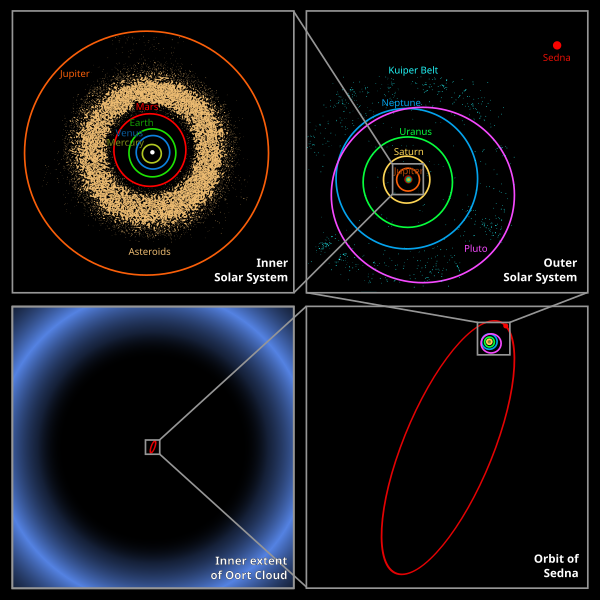
Both Sedna and 2012 VP113 were found at points in their orbits when they were closest to the Sun. The point of closest approach for 2012 VP113 is 80 times the distance between Earth and the Sun, or 80 AU (astronomical unit). The most distant point of its orbit is just over 450 AU. In comparison, Sedna’s closest approach is 76 AU, and its most distant point is at 1,000 AU.
Both 2012 VP113 and Sedna have similar type orbits, as do a few other objects near the outer limit of the Kuiper Belt (a region that stretches out beyond the orbit of Neptune). The similarities of all these orbits suggests that there is at least one unknown massive world farther out there perturbing the orbits of Sedna, 2012 VP113 and other known objects into their current orbital configurations. Sheppard and Trujillo suggest a super Earth or an even larger object that lies perhaps hundreds of AU even farther out could create the shepherding effect seen in the orbits of these objects (which are too distant to be perturbed significantly by any of the known planets).
The Oort Cloud and Kuiper Belt regions of the outer solar system are giving us some of the most exciting finds in solar system exploration. The Inner Oort Cloud is the focus of intense observation now because it can give hints about the history of our solar system’s formative period. It begins between 1,500 and 2,000 AU from the Sun. Some scientists think that a rogue planet was ejected from the giant planet region of the solar system and plunged through the Inner Oort Cloud on its way out, disturbing the orbits of objects that “live” there, possibly sending them inward toward the Sun. It’s also possible that the gravitational effect of a passing star might have sent some objects racing into the inner Oort Cloud. And, another theory suggests that objects in this region of space used to be planets around stars that were once closer to the Sun in the solar birth cloud.
Oort Cloud compared to rest of the Solar System. Courtesy NASA.
It has only been in the past few decades that terms like “inner Oort Cloud” came into use by planetary scientists. We knew of the larger Oort Cloud, which is the outermost region that surrounds the rest of the solar system like a large shell. It contains a reservoir of icy objects. Now, with new discoveries like this one, astronomers can further refine specific regions based on characteristics of the objects they contain, such as the Inner Oort Cloud, which stretches about the orbit of Sedna out to a distance of 1,500 AU. At that point, the Outer Oort Cloud begins and stretches out to at least a quarter of the distance between the Sun and Proxima Centauri (its nearest stellar neighbor). The difference between Inner and Outer? The Outer Oort Cloud is more susceptible to gravitational influences from nearby or passing stars, whereas the objects in the Inner Oort Cloud have more stable orbits and are much less likely to be disturbed by traffic outside the solar system.
The outer solar system regions beyond Neptune — the Kuiper Belt, Trans-Neptunian Space, the Inner Oort Cloud and the larger Oort Cloud — have often been called the “final frontier” in terms of our ability to explore them. The discoveries of 2012 VP113, Sedna, Eris and others in the closer-in regions of this “frontier” are telling us much about that region of space, and hint at further surprises in our understanding of the history of the solar system. I can’t wait to see what Trujillo, Sheppard and others find the next time they aim their scopes out that way!