
Category Archives: astronomy

ISS It Up?

You May Have Seen It
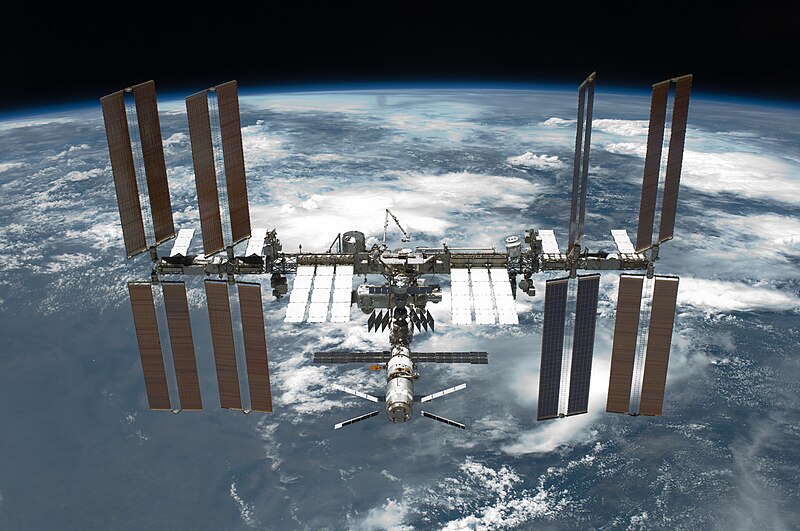
The International Space Station.

Everybody’s heard of the International Space Station (ISS), right? It’s NASA’s orbiting multi-national lab that has been circling Earth for years. Periodically astronauts go up there or come down after lengthy stays, and the station is resupplied on a regular basis through capsules launched by the Russians. It looks amazing, and I’d love to go there someday. When I was growing up, the space station was a futuristic dream. Now that I’m grown up, it’s there. It’s circling Earth and people are using it to do work in space. (You can learn more about it on NASA’s ISS site.)

Did you know that you can see the ISS?  Not all the time, but at times when its orbit takes it over your area.  And, it won’t look like this picture, but more  like a white dot moving across the sky. But, it’s pretty neat to watch it and think about how there are people up there living and working in space.

How do you find out when you might see it?  Easy: go to the web site Spaceweather.com/flybys (if you’re in North America) or Global Flybys (if you’re elsewhere in the world), and put in your zip code or country information. The page will return a list of whatever satellites will be visible from your area, the rise and set times, and more information that will help you find the object as they pass overhead. You can also use SpotTheStation, offered by NASA.

So, what will it look like once you find it?

Funny about that: it kind of looks like an airplane going slowly overhead. Before I knew where to look (years ago), I used to think I was SEEING an airplane.  But, no flashing lights, no contrail. Didn’t take me long to figure out: aha, that’s the space station!   I figure that a LOT of people have actually seen the space station, but didn’t know they were seeing it.

So, use the links to find out what’s overhead at your location.  ISS isn’t the only thing out there; if you’re lucky, you might see the Hubble Space Telescope or other satellite.  They’ll look like bright pinpoints of light moving slowly across the sky. And, you’ll get a little thrill out of spotting it. I guarantee it.

A Solar “Twin” and Its Planet

What’s it Like?

We live in an age of planetary exploration beyond our solar system. Ever since 1995, when the first extrasolar planet was discovered, astronomers have been finding distant worlds in ever greater numbers. What was once a science fiction idea is now reality: planets around other stars.

The  most recent discovery was made by the European Southern Observatory using the HARPs planet hunter instrument, in conjunction with other telescopes. This one was in a star cluster, which is a difficult environment for a star to exist in.  Interestingly, stars that are born in clusters don’t always stay in the clusters.  So, that makes finding a planet around a star in a cluster quite a rare treat. What’s even MORE rare is that one of the stars with a newly found planet is a solar twin. That is, it is nearly identical to the Sun. It has a similar mass, spectral class, and chemical composition to our own star. And, now we know there’s a planet orbiting it.

An artist’s concept of a planet orbiting a solar “twin” in a star cluster that lies about 2,500 light-years away in the constellation Cancer, the Crab. Courtesy ESO.

What’s that planet like?  Very likely NOT Earthlike. This is because it orbits much closer to its star than the star’s habitable zone. That’s the area around a star where liquid water could exist on the surface of a planet orbiting there. If the planet is too close, it’s likely getting baked by its star. So, not a good candidate for E.T.

The fact that this planet, and two others, show up around stars in clusters is providing an interesting conundrum for astronomers to solve: star clusters are not particularly welcoming places for planets, so why are these cluster stars blessed with worlds?  The cluster these stars and planets live in (Messier 67) is a type of open cluster that stays together as a cluster longer than many other such groupings because it has a higher density of stars than other clusters. Perhaps that provides a clue to the existence of planets around cluster stars. It also tells me that planets are really much more common in the galaxy than we used to think. That’s science at work: as we improve our techniques for observation, we’re seeing things that were out there all along—just waiting for us to find them. I can’t wait to see what kinds of worlds astronomers find next!