
Category Archives: astronomy

Zoom to Andromeda

Pushing the Boundaries of Ground-based Observing

A chart showing how to find Andromeda (also often called the Great Andromeda Nebula) in the late night/early morning skies in August. Made using Stellarium.
A chart showing how to find Andromeda (also often called the Great Andromeda Nebula) in the late night/early morning skies in August. Made using Stellarium. Click to enlarge.

If you go out very late tonight or early in the morning, look around for the constellation Cassiopeia. It’s a W-shaped star pattern high in the northern part of the sky. Not far away from it, you might spot a little schmear of light that looks like a little oval-shaped cloud. This is the Andromeda Galaxy, which is the closest spiral galaxy to our own Milky Way. It lies about 2.5 million light-years away, so the light that you see coming from it as you view left the galaxy about the time some of our earliest ancestors were living in caves.

If you look at Andromeda (M31 for short) through a decent back-yard type telescope, you can make out a spiral galaxy, but it’s a pretty fuzzy view. And, if you could zoom the view using a professional observatory to see individual features, it would be focused on only a part of the galaxy since such a telescope would like magnify the view so much to get the features you want. As far away as M31 is, it can quickly fill a field of view as you zoom in. So, astronomers have been seeking new and better ways to image it completely and sharply from the ground, and use more sophisticated data analysis techniques to bring out individual features in M31 (and any distant object, really) while still capturing the entire scene. They want the beauty of a panoramic scene with the clarity of a close-up.

A complete view of M31 taken by HSC, which allows Subaru Telescope to observe an extremely wide field of view, equal to nine times the area of the full moon. Odd-colored regions at the edge occur because the boundary area of the image circle is hard to process and observed area does not perfectly coincide in the three bands seen by the camera. (Credit: HSC Collaboration / Kavli IPMU) (Click to get full-resolution view.)

The Subaru Telescope of the National Observatory of Japan recently took a full view of the Andromeda Galaxy using the telescope’s powerful Hyper Suprime-Cam (HSC) to try and get that high-resolution panoramic view. The data were processed through special software by scientists affiliated with Subaru, the Kavli Institute for Physics and Mathematics of the Universe, and Princeton University. The result is a spectacularly sharp view of our distant neighbor in space. If you zoom in on the full-resolution image, you can see individual stars in the galaxy, which is just amazing.

The amount of data needed to create an image of this size and clarity is quite large, and requires what’s called “pipeline” processing. As more of these high-resolution data sets stream from the world’s telescopes, such pipelines will grow and evolve. This “first light” image from the HSC-equipped Subaru Telescope shows the power of good equipment and high-end processing to bring dim, distant objects in the universe “closer” to us for study. The fact that this comes from a ground-based telescope on the summit of Mauna Kea in Hawai’i, which is well above much of Earth’s atmosphere (but still has to deal with some atmospheric interference) is really astounding.

Take some time to browse the larger image and check out some of the other images that the Subaru folk posted on their page. Let your eyes zoom to Andromeda through Subaru’s high-resolution camera, and let your imagination explore this distant stellar city.
A Cometary Sargasso Sea

A Graveyard of Dead Comets

Back in the days of sailing ships, sailors found interesting areas in the world’s ocean. The Sargasso Sea was one of them. It’s a region in the North Atlantic Ocean where currents create the North Atlantic Gyre. Those currents bring in all kinds of debris, which remains stuck in the region. It’s also rich in a type of seaweed called Sargassum. Occasionally ships would get stranded there for brief periods of time due to lack of wind power to push their ships along. The Sargasso isn’t an especially deadly place, but it has been an area of great interest to marine biologists.

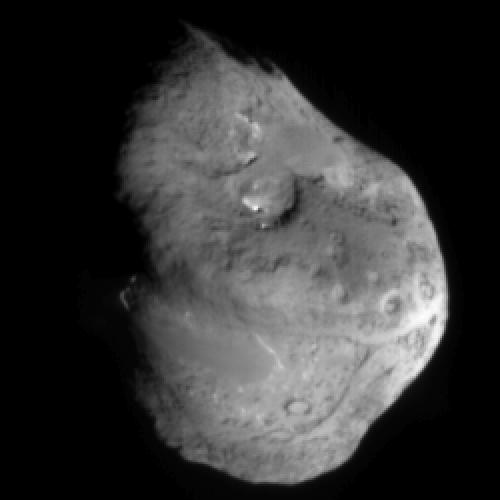
The nucleus of Comet Tempel 1, without its coma. "Lazarus comets" in the Asteroid Belt might have this lumpy look with less surface ice. Courtesy GALEX/Caltech
The nucleus of Comet Tempel 1, without its coma. “Lazarus comets” in the Asteroid Belt might have this lumpy look with less surface ice. Courtesy GALEX/Caltech

Our solar system has a Sargasso-like region called the Asteroid Belt, which contains a LOT of debris that has long thought to be leftovers of planetary formation that couldn’t quite get it together because of gravitational interference from Jupiter. It’s also apparently home to a lot of “dead” cometary nuclei.  This area of the solar system contains more than a million objects that range in size from a meter to more than to 800 kilometers.

A team of astronomers from the University of Antioquia, Medellin, Colombia, have examined this region of space and discovered what they call a graveyard of dead comets in the belt. Astronomer Ignacio Ferrin has just published a paper in the journal Monthly Notices of the Royal Astronomical Society, describing how what observers long thought were dead rocks in the Asteroid Belt actually turned out to be dormant comets stuck floating around out there in a solar system Sargasso.

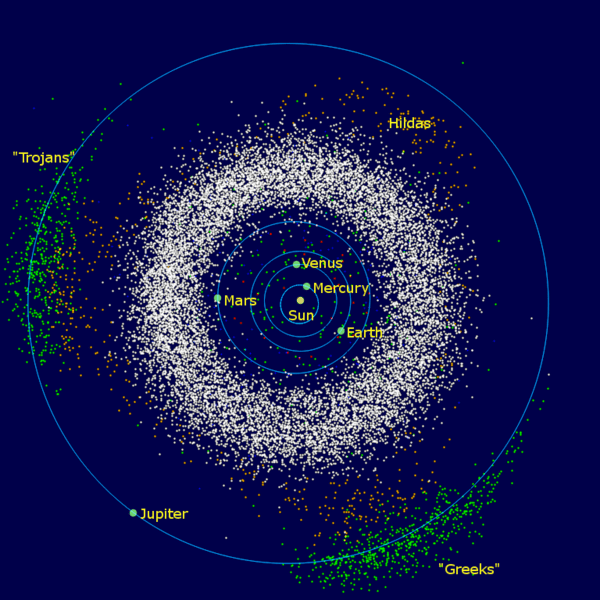
A schematic of the Asteroid Belt; the Main Belt is where these "Lazarus Comets" are thought to exist. Courtesy NASA/Caltech/JPL
A schematic of the Asteroid Belt; the Main Belt is where these “Lazarus Comets” are thought to exist. Courtesy NASA/Caltech/JPL

“Dormant” means that these cometary corpses could come back to life. All they need is a Sunward nudge, and many of them would perk up as their remaining gases and ices started to sizzle again. A little push from Jupiter (via its strong gravitational pull), and the shape of any of these objects’ orbits could change, sending them closer to the Sun.

According to Ferrin and his team, the main region of the Asteroid Belt had a population of comets that formed “in situ” (meaning they formed right where they’re found) as the solar system formed. This area was once bristling with thousands of very active comets millions of years ago. As they aged and lost their outer ices, these comets began to quiet down. Ferrin’s team has studied at least 12 of these once-glorious comets that somehow got a little push toward the Sun and began fizzing again. There are very likely many more of what Professor Ferrin calls “Lazarus Comets” circling out in the Belt, just waiting for the chance to get a little closer to the Sun and get active again. Interested in learning more about how Ferrin and his team studied these comets and their implications for solar system history?  Check out their paper here or, if you’re a member of the Royal Astronomical Society, you can learn more here.