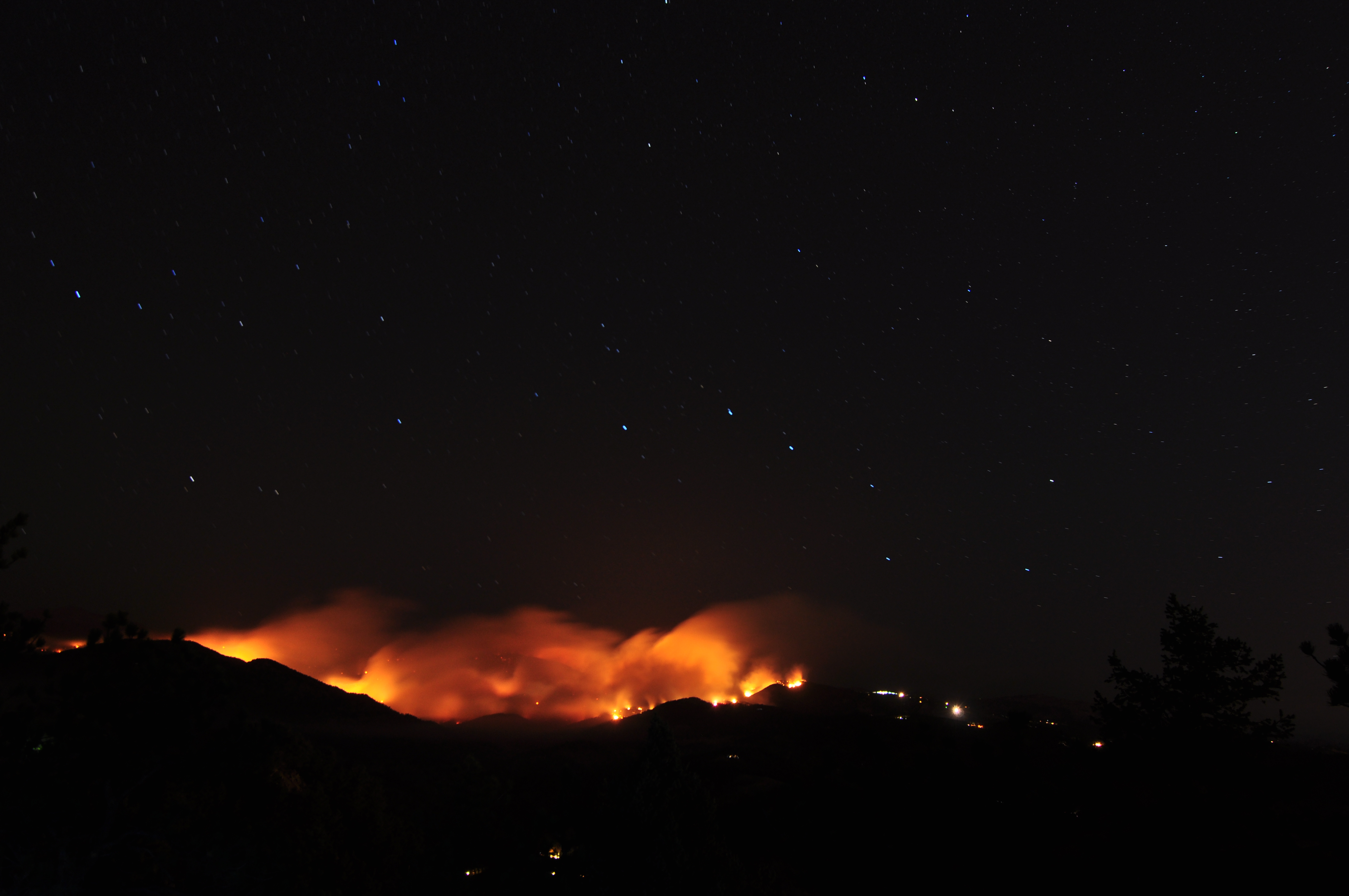
The view west of Boulder Colorado at night, looking north, with a backdrop of flames from the Four Mile Fire. Image courtesy of MyTownColorado.com and William Maher III. Click to enlarge.
I think this picture speaks for itself, but in case you haven’t been following the news in Colorado, we are witnessing a wildfire that has (as of this writing) destroyed at least 93 buildings (homes and other structures), spread across more than 7,000 acres, and caused the evacuation of thousands of people. It began on September 6 around 10:30 a.m. and spread quickly. Many of us who are outside the danger zone but close enough to see have been taking photographs of the fire. I live about 9 miles south of the fire and we’ve watching the huge clouds of smoke during the day and the glowing sheets of flame at night (when visible). This is one of the most spectacular, clearly showing the naked stars over the fire scene. It was taken by William Maher III, probably on September 6, 2010. You can see more images at MyTown Colorado.
I’ve posted some of my own pictures taken on the first day of the fire here (FB mirror here).
This is one of those stories that seems almost impossible at first glance: making water in space? No way! Wouldn’t it all freeze out there?
Well, yeah… but you can get water vapor if you happen to have really hot stars near a nebula that is rich with molecules of hydrogen gas (H2), carbon monoxide (CO) and silicon monoxide (SiO). Those hot stars emit loads of ultraviolet radiation, which is energetic enough to break the oxygen molecules free. Once they are, they readily will bond with the hydrogen gas molecules to form water. Add in a heat source (like the nearby dying star and the heat from other stellar neighbors) and you get water vapor.
The star IRC+10216 -- where astronomers are studying a cloud of water vapor surrounding the star.
Of course, the water needs to have a stable environment to exist in, like a warm envelope of gas and dust. Such a curcumstellar envelope is where the European Space Agency’s Herschel spacecraft has made a significant discovery. It observed a cloud surrounding the dying star IRC+10216 and studied its steamy vapor cloud. This stellar sauna has been known to exist since astronomers first saw evidence for the vapor in 2001.
At first, astronomers thought that maybe the dying carbon star was heating up nearby cometary bodies and creating the water vapor. They even suspected that dwarf planets may have also been melted to make the cloud. However, those ideas needed to be proved, and for that, astronomers needed a telescope with instruments that could peer through the cloud of dust and steam surrounding the star.
Herschel can do the job because it has infrared capability, which allows it to see where optical telescopes cannot due to the thickness (opacity) of the cloud that surrounds the star. Some observations had already revealed clumpy structure in the dusty envelope around IRC+10216. And, there was that water vapor in the areas of the cloud around the clumps.
So, astronomers trained Herschel’s infrared “eyes” to the cloud and measured the temperature of the water vapor. It ranged from -200 degrees Celsius to 800 degrees Celsius. That’s quite warm, which means that the water vapor is being formed quite close to the star — closer, in fact, than comets could exist.
This is an interesting result and means that other carbon stars could also have the same type of water vapor cloud around them, provided there are sources of ultraviolet radiation nearby. So, the next step is for astronomers to look at some of those carbon stars with Herschel and see what they can find. Stay tuned!