
Category Archives: astronomy

The Mostest

Exploring the Superlative Universe

The Space Shuttle: how fast is it? How fast could it go? (Artwork depiction courtesy National Geograhic.)
The Space Shuttle: how fast is it? How fast could it go?

Do you want to know what the fastest things are in the universe?  The most explosive?  The biggest and smallest? What objects do you think are faster, bigger, smaller, or most explosive?  For the fastest, I figured maybe it would be the high-speed, relativistic jets coming out from the centers of galaxies, where black holes live and snarf up surrounding matter.

For biggest and smallest, I figured superclusters of galaxies and sub-atomic particles, respectively. And, most explosive?  It would have to be the Big Bang, right?

All those things are examples of superlative things (from a Middle English perversion of a late French term superlatif, which came from the Latin superlatus, meaning “lifted up to the highest degree, most eminent”, etc.).

An asteroid the size of Manhattan may have contributed greatly to the death of the dinosaurs some 65 million years ago. Is that the biggest explosion in the cosmos?
An asteroid the size of Manhattan may have contributed greatly to the death of the dinosaurs some 65 million years ago. Is that the biggest explosion in the cosmos? (Artwork depiction courtesy National Geograhic.)

Superlatives in the cosmos are the topic of a series of three programs being shown on National Geographic beginning this weekend called Known Universe. I’ve been watching a preview copy of the series (thanks to the NatGeo folks!) and even I’ve learned some new things.  Like, what do you think the fastest object to be rocketed into space?  It turns out to be the new Horizons spacecraft which is traveling at toward a rendezvous with Pluto in 2015 at around 18 kilometers per second.  The series is chock-full of facts like that.

So, why study superlatives in the cosmos?

Because, so far as we know the biggest and smallest and fastest and slowest and most explosive things all obey the same laws of physics, throughout the universe. They teach us about conditions in other places, and how planets and galaxies and stars can change and evolve. These things help us understand the universe a bit better, even if what we’ve learned is the smallness of the atoms in a strand of hair or the speed of particles as they are accelerated in a physics experiment. In other words, superlatives help us understand the common places as well as the exotic in the cosmos.  That’s part of the message of this series. Maybe as you watch it, you’ll discover new things yourself.  Go check it out — starting Sunday night, January 15th on National Geographic Channel (in the U.S.).
What are You Lookin’ At?

Stargazing Much?

Yes, I know it’s winter for those of us in the northern hemisphere, although the wintry weather should start giving way to the warmer stuff in a few weeks.  We had a taste of it this past weekend out here in the sticks where I live. The sky was clear and the Moon has been gorgeous.

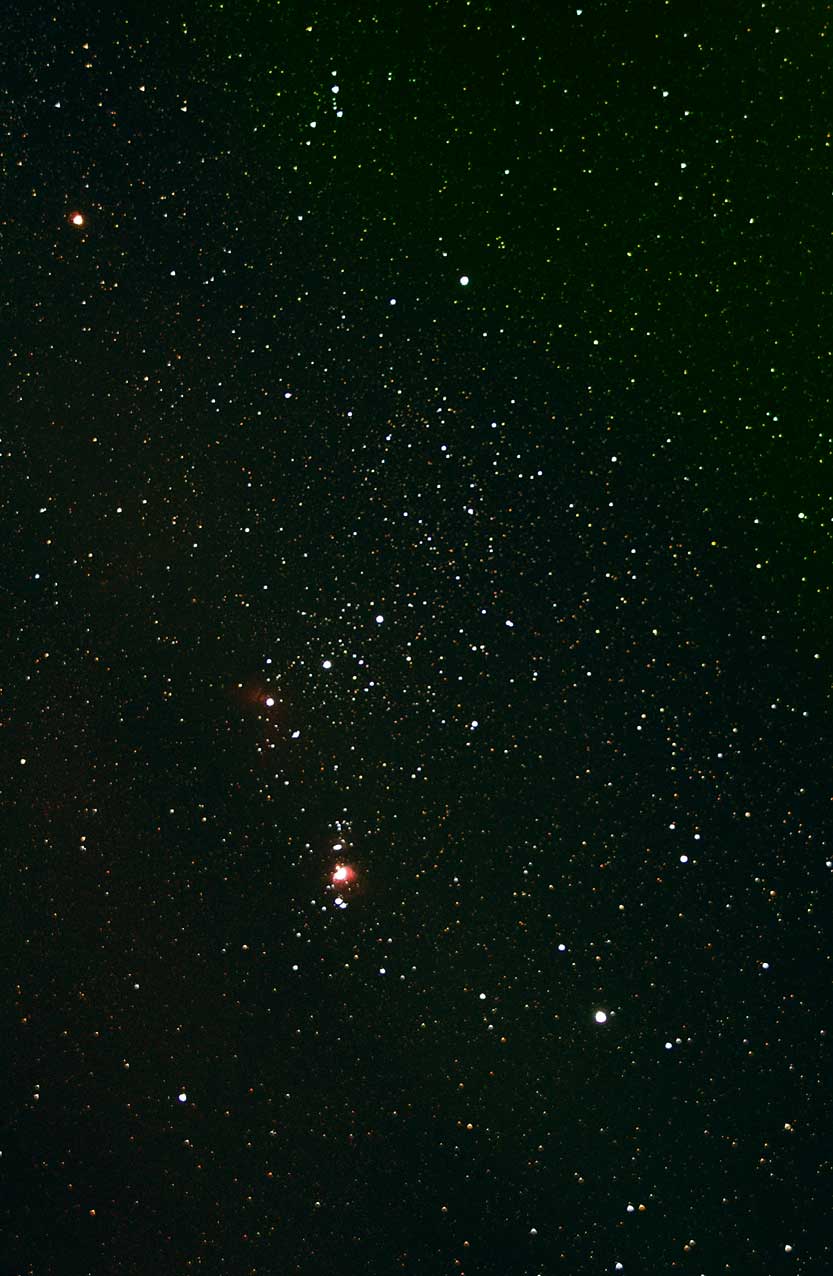
Orion, courtesy Richard Drumm, the Astronomy Bum. (Click to enlargenate.)

This is the time of year when the winter constellations are starting to slip lower in the west earlier each evening. Orion’s still holding up his part of the sky — so, if you want to see a starbirth region and several bright stars, go check out the Mighty Hunter while he’s still available.

The starbirth region is the Orion Nebula (also called M42), and it’s the faint fuzzy patch located below the three Belt Stars in the center of the constellation. There are hundreds of young stars shining out in the Nebula, including the four brightest which are collectively called the Trapezium (the reddish blob in the image at left). They are relative newborn stars, still eating away at the cocoon of gas and dust that gave them birth.

A star map showing the constellation Orion and associated objects and stars. (Courtesy Wikimedia)
A star map showing the constellation Orion and associated objects and stars. (Courtesy Wikimedia--click to biggify.)

Astronomers have been studying the Orion Nebula in great detail, and have also found brown dwarfs and possible planetary systems in the region. What we can see easily through smaller telescopes and binoculars is part of a larger complex called the Orion Molecular Cloud, which contains a number of other objects you can see with medium-to-large telescopes. These would be the Flame Nebula, Barnard’s Loop, and the Horsehead Nebula. So, give that one a look, if you can, if for no other reason than the exotically named objects you can observe.

The bright stars are Betelgeuse and Rigel. Although not part of Orion (and not seen in this picture), you can’t miss Sirius (the three Belt Stars point right to it).  Sirius is the brightest star in the sky and is actually a binary star that’s really a white dwarf.  At 8.7 light-years distance, Sirius is one of the Sun’s closer neighbors.

Orion’s a good start for stargazing these chilly nights (and yes, it can get chilly even in warm climates), so go check it out. Bring along the binoculars if you can. And, if the Moon is bright, check it out AFTER you look at other parts of the sky (otherwise if you look at it first, you blow your dark adaptation).

Enjoy!