
Hidden in the Light

How Spectroscopy Fills in the Blanks in our Knowledge

Back when I was in graduate school, I was part of a Hubble Space Telescope team that had an instrument called the Goddard High Resolution Spectrograph onboard the telescope. I had a lot to learn about spectroscopy, and my team leader introduced me to the topic by saying, “There are two ways to clear a crowded theater: yell “fire” or announce “And now we’re going to hear a talk about spectroscopy.”

It was a wry remark with more than a grain of truth in it, particularly for folks who have grown up seeing pretty space pictures and don’t really think about the other ways that light from a distant object can teach us something about it. Of course, astronomy IS more than pretty pictures, but in the words of one NASA public information office I used to know, “Pretty pictures is what hooks ’em.” That may be true, but if you want to really learn everything about an object, you study all the wavelengths of light it emits (or reflects). There’s a LOT of information hidden in the light.

This is a spectrum of Comet Halley, made using an instrument sensitive to infrared (IR) light. It was taken from M. Combes and a team of observers and published in Icarus, 76 404 1988. The peaks in the line show that a greater amount of light with that wavelength was being emitted from the sample than other wavelengths. The labels show you the emissions from different compounds in the comet. You can see water (H20), carbon dioxide CO2), carbon monoxide (CO), and so on. Courtesy NASA.

So, what does spectroscopy tell us? It’s a specialized area of study that looks at the interaction between matter and electromagnetic radiation (light). It’s basically a chemical analysis using light emitted or absorbed or reflected by objects to tell you something about them. Essentially, you take the light from the object and look at it with a special instrument, and examine the wavelengths in great detail.

Astronomers often talk of taking a spectrum, with the results being “spectra”. Those spectra tell them whether a given element (such as hydrogen) or compound (such as water or oxygen) is emitting or absorbing light. They can tell what minerals are on the surface of a planet (like the instruments onboard the Mars Curiosity rover are doing), or what compounds exist on a comet (such as the spectral plot shown here). Spectra can also tell them how fast an object is moving, whether it has a magnetic field (and how strong it is), and its temperature.

That’s the executive summary of spectroscopy and if you want to learn more, visit this page at NASA.

So, how does it work in practice? Let’s take the New Horizons mission to Pluto as an example. It has two spectrometers (essentially instruments that measures specific parts of the electromagnetic spectrum).

The Alice spectrometer onboard New Horizons. Courtesy NASA and the New Horizons mission.

One is called Alice, and it is an imaging spectrometer sensitive to ultraviolet light. That means it measures the separate wavelengths of ultraviolet light AND produces an image of whatever it’s looking at each wavelength it studies. For those of you who want the specs, Alice will look at extreme and far UV wavelengths from approximately 500 to 1,800 Angstroms.

What will Alice study? Its main target is the Pluto atmosphere, which is active and changing. Alice will detect the elements and compounds that make up the think blanket of Plutonian “air” that envelopes this dwarf planet. It will also look for an ionosphere (a layer of charged particles at the top of the atmosphere), and measure the atmosphere’s temperature and density. It will do the same work at Pluto’s moon Charon. Sometime in mid-June Alice will “detect” Pluto, and begin to send back data.
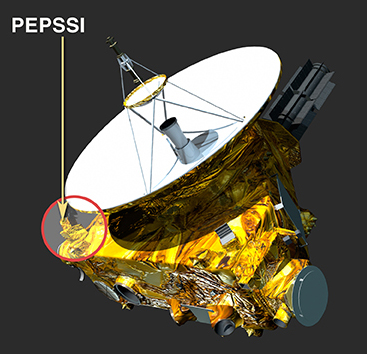
The PEPSSI spectrometer aboard New Horizons. Courtesy NASA and the New Horizons team.

The other spectrometer aboard New Horizons is called PEPSSI (short for Pluto Energetic Particle Spectrometer Science Investigation). It is built to look for neutral atoms that escape Pluto’s atmosphere only to become energized when they interact with the solar wind. What could be escaping from Pluto? Molecular nitrogen (which is the main part of Pluto’s atmosphere), carbon monoxide, and methane (for starters). They get energized and broken apart as they escape from the planet and absorb ultraviolet light from the Sun. They also get carried away on the solar wind, and so New Horizons should be able to detect a “tail” of such energized particles as it moves away from Pluto.

It’s also helpful to think of PEPSSI as a very efficient particle counter. It has already been studying the plasma environment as it approaches Pluto, giving scientists useful data about the solar wind at that distance from the Sun. It will start “seeing” Pluto very shortly before the spacecraft sweeps past the dwarf planet on July 14th.

Astronomy IS the study of light, and up until Isaac Newton’s invention of spectroscopy in 1666, and further developments in the 19th century, that astronomers were able to study the universe in wavelengths beyond the visible light we are familiar with. Spectroscopy is, in a way, applied chemistry to the stars and planets. In that respect, spectroscopy is actually quite a bit more exciting than you’d expect. Without it, our knowledge of the universe would be incredibly incomplete.

“It Just Gets More Exciting from Here!”

Possible Pluto Features Sighted

The news from the New Horizons mission just keeps getting better. The latest images, combined into an animation, show what might be a polar cap on the dwarf planet. It’s the best picture yet of this distant, tiny world. The good news is, as the spacecraft gets closer, the images are just going to get better!


The 3x-magnified view of Pluto highlights the changing brightness across the disk of Pluto as it rotates. Because Pluto is tipped on its side (like Uranus), when observing Pluto from the New Horizons spacecraft, one primarily sees one pole of Pluto, which appears to be brighter than the rest of the disk in all the images. Scientists suggest this brightening in Pluto’s polar region might be caused by a “cap” of highly reflective snow on the surface. The “snow” in this case is likely to be frozen molecular nitrogen ice. New Horizons observations in July will determine definitively whether or not this hypothesis is correct. In addition to the polar cap, these images reveal changing brightness patterns from place to place as Pluto rotates, presumably caused by large-scale dark and bright patches at different longitudes on Pluto’s surface. In all of these images, a mathematical technique called “deconvolution” is used to improve the resolution of the raw LORRI images, restoring nearly the full resolution allowed by the camera’s optics and detector. Courtesy: NASA/Johns Hopkins University Applied Physics Laboratory/Southwest Research Institute

You might wonder how a spacecraft traveling at 14.57 kilometers per second (relative to the Sun), now more than 31.86 astronomical units (that’s nearly 32 times the distance between Earth and the Sun), can send back increasingly better images? It starts with a camera called LORRI, which stands for Long Range Reconnaissance Imager. It’s a small, but powerful instrument, weighing less than 20 pounds and using up less than six watts of electricity. The “guts” of the instrument is a 8.2-inch telescope aperture that focuses visible light onto a CCD. Think of it as a digital camera attached to a telescope. It’s quite small, but powerful and is built to withstand the cold, radiation-filled vacuum of interplanetary space. All of its data are collected on board, and then sent back to Earth via an X-band communications system that includes several antennas.  They communicate with the Deep Space Network, which then relays the data to the waiting team members. You can actually see when New Horizons is communicating with Earth at DSN Now.

As New Horizons gets closer to Pluto, its images will improve dramatically. Already, it has shown us that Pluto is a world with surface features. Now, we just have to wait to see what those features are. Starting in mid-May, the images will start to be better than Hubble quality resolution, and that’s when things will really start to get exciting. At flyby, LORRI will be providing looks at the surface that will resolve features only 50 meters (about 150 feet) across. That means we’ll be able to see things such as craters, cliffs, chasms, whatever it is that is making Pluto’s surface look alternately bright, dark, and interesting.

I was listening to the New Horizons team talk about these latest images via telecon yesterday and could really hear the excitement in their voices. My friend Alan Stern (the PI for the mission) whom I’ve been talking with quite a bit in these last few months’ run-up to the flyby, summarized the situation for all the listeners. “After traveling more than nine years through space, it’s stunning to see Pluto, literally a dot of light as seen from Earth, becoming a real place right before our eyes,” he said Alan Stern. “These incredible images are the first in which we can begin to see detail on Pluto, and they are already showing us that Pluto has a complex surface.”

At closest approach, the spacecraft will be about 12,500 kilometers above the surface of Pluto, and that will really give LORRI and the other New Horizons instruments something to show us. So, stay tuned, as they say.

Pluto huggers everywhere: our time is coming!


Exploring Science and the Cosmos

Spam prevention powered by Akismet