
Letters to Pluto

Less Than 1 AU and Counting…

Dear Pluto,

A few days ago the New Horizons spacecraft passed an important milestone: it was 1 A.U. from its major target: Pluto. that means YOU!  That also means it was as far away from you as Earth is from the Sun. By now, it’s even closer.  A lot of us here on Earth are keeping track of the spacecraft’s whereabouts by checking the New Horizons web site counter that lets us know where things stand for the mission.

A few days before THAT, New Horizons did a little mid-course correction to get it lined up even more precisely for its trip past you on July 14, 2015. At that point, the spacecraft was nearly 3 billion miles (4.77 billion kilometers) from the Sun, and that’s a record for a trajectory correction burn!

Images of Nix and Hydra. Courtesy New Horizons mission.

The excitement is building as the spacecraft gets closer and closer. The cameras are studying the Pluto system and just a month ago were able to spot the two tiny Plutonian moons Nyx and Hydra. As things progress, there will be more images and data, showing us an increasingly larger-looking Pluto and its worlds.

This is really a huge milestone project. One of my friends is the principal investigator for the mission—Alan Stern. He has boundless enthusiasm for this mission, which stretches back as long as I’ve known him. We were in graduate school at the same time at the University of Colorado, and had the same advisor. I remember going to his thesis defense, and hearing him give talks about Pluto and comets, and I’ve always learned a lot from him. I’m proud to continue our friendship many years later.

As you might expect for the PI of a mission to an outer world, Alan embraces all things Pluto—and I do mean ALL! Just today he sent me a link to a page called “Janet’s Planet”, which contains a cute Youtube video about how kids can connect with Pluto. The title of the vid is #DearPluto and it challenges kids to write a letter to Pluto. Alan has recorded his OWN video letter for Janet’s page, which you can see on HER Youtube page. Anybody can record or write a letter to you, Pluto. I think it’s really jazzy way to get kids hooked (even more) on Pluto! Even better, getting Plutophiles everywhere to get with their inner kid and send a note to their favorite world.

The next few months will be pretty exciting for Plutophiles, and we’re keeping an eye out on you, Pluto. It won’t be long before we are there and checking you out!

With great excitement,

Your friends on Earth.
 

Water Worlds in the Solar System

Water, Water, (Nearly) Everywhere

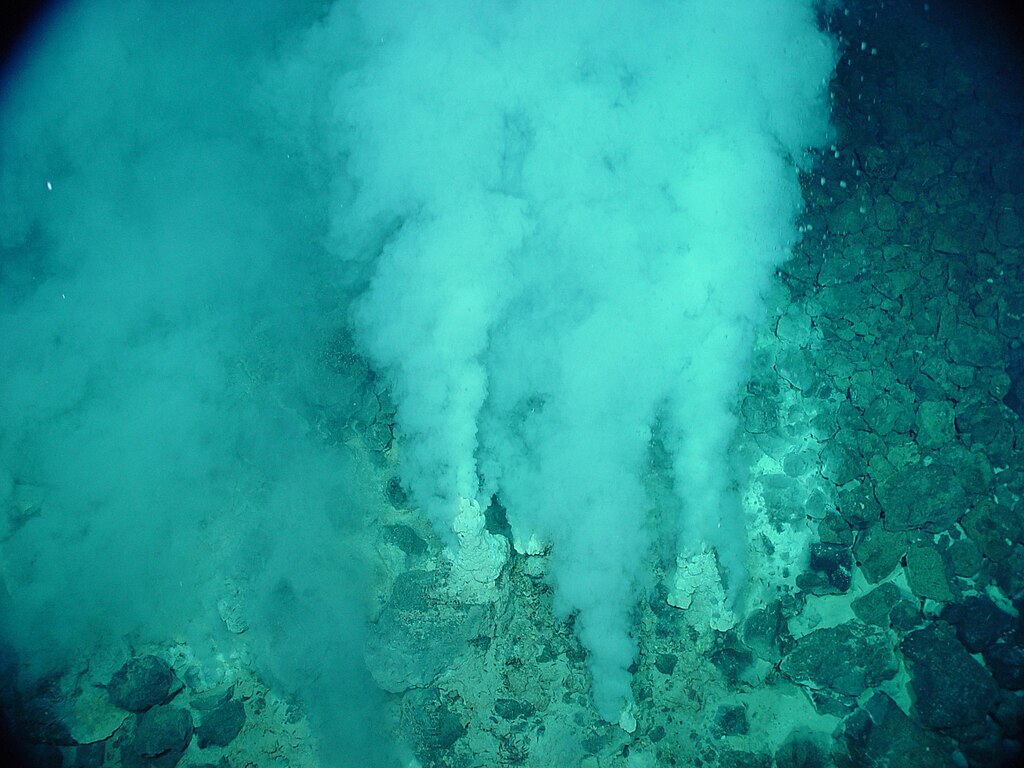
A hydrothermal vent on Earth’s deep-sea bottom. Despite the extreme conditions here (boiling hot water and high pressures), life thrives around these vents. The discovery of subsurface oceans and possible hydrothermal action on other worlds in the solar system raise the question: can life exist in those places? Courtesy NOAA.

With the latest news about Jupiter’s moon Ganymede (and its likely ocean), plus Enceladus and its subsurface ocean and plumes, and the near-certainty that dwarf planet Ceres has a subsurface ocean, our understanding of the solar system is changing when it comes to water.

Images and data from such spacecraft as the Cassini mission at Saturn and Hubble Space Telescope observations of distant worlds in the solar system are giving us a look at just how water may be near-ubiquitous (although not always completely obvious) among the planets, dwarf planets, asteroids, comets, and moons. I see this as more of a hole in our understanding of these places, rather than lack of water in the solar system. It turns out the water’s always been there. We just had to change our view of where it is and how it looks so we could understand it. Now that we know what to look for, water is indeed in many places.

This is artist’s concept of the moon Ganymede shows what this little world looks like as it orbits the giant planet Jupiter. The Hubble Space Telescope and its ultraviolet-sensitive STIS instrument observed aurorae on the moon that are controlled by Ganymede’s magnetic fields. Two auroral ovals drift over northern and southern mid-latitudes. Hubble measured slight shifts in the auroral belts due to the influence of Jupiter’s own immense magnetic field. This activity also allows for a probe of the moon’s interior. The presence of a saline ocean under the moon’s icy crust reduces the shifting of the ovals as measured by Hubble. Just as aurorae are produced on Earth by the action of charged particles in its magnetosphere, Ganymede’s aurorae are produced by energetic charged particles that cause the gases to fluoresce (glow). NASA, ESA, and G. Bacon (STScI)

Of course, we don’t SEE the water at these places, at least not in the form of lakes and ponds and rivers and oceans. We have to infer its existence from other data. That’s because the water is hidden from our view in subsurface oceans and lakes. But, that water has an effect on its world that can be measured. In the case of Enceladus, we do see geysers pluming out from below the surface, and they are one of the important indicators of a vast ocean beneath that icy landscape. In the case of Ganymede, the Hubble Space Telescope’s STIS instrument (sensitive to ultraviolet light) caught the action of aurorae around this little moon. The actions of those magnetic storms belie the existence of a saline (salty) ocean

Why is water so important? For proponents of the search for life elsewhere, water is listed as one of the three main ingredients for life: water, warmth, organic material (to live on). If a place has those three, the chances that it can sustain life is much better than a place without them. There’s even some thought that if a place has two of the three, it could still sustain some type of life. That’s the province of astrobiology, the science that figures out how and where life could exist on other worlds.

Continue reading Water Worlds in the Solar System

Exploring Science and the Cosmos

Spam prevention powered by Akismet