
Ceres Gets a Visitor

Dawn Mission Achieves First-ever Orbit around a Dwarf Planet

NASA’s Dawn spacecraft has become the first mission to achieve orbit around a dwarf planet. The spacecraft was approximately 38,000 miles (61,000 kilometers) from Ceres when it was captured by the dwarf planet’s gravity at about 4:39 a.m. PST (7:39 a.m. EST) Friday. These images were taken while Dawn was still inbound, on March 1, 2015.

This year is truly the Year of the Dwarf Planet! Earlier today, NASA’s Dawn spacecraft slipped into orbit around dwarf planet Ceres and settled in for a long-term study of this little world. Think about what this achievement means. First, this isn’t the first world the spacecraft has orbited. It also studied the asteroid Vesta for about a year. That makes it the only spacecraft (so far) to orbit two extraterrestrial targets.

Second, it will be the first of two missions this year to give us up-close looks at dwarf planets. The long-awaited New Horizons mission to Pluto and beyond will finally show us some high-resolution details of Pluto, the infamous dwarf planet that is at the heart of so much controversy about what the word “planet” means. I hope for all our sakes that the science we get from these two missions FAR overshadows the controversy. These are worlds. They ARE planets. The term “dwarf” in their  names is not an insult — it’s a descriptor loaded with a LOT of meaning to planetary scientists, who should know what planets are (despite the best efforts of the IAU to dictate to them otherwise). Just as there are types of stars (dwarfs, giants, etc.) and types of galaxies (dwarfs, lenticulars, spirals, etc.), there are types of planets. The cosmos is big enough to contain all the types we want. We just need to recognize that and move on.

Already, Ceres is tantalizing us with a bright spot, a cratered surface, and various other characteristics. This tells ME that this little world, as well as Pluto, has some secrets to share, and that those secrets will enlarge our understanding of the solar system. Knowing our own neighborhood is an important first step toward understanding worlds far beyond our own star, and it helps us “get” where we are in the cosmos. So, stay tuned. Ceres has a lot to show us, and in a few months, Pluto will take its place on center planetary stage and continue the show of a lifetime.



A Radio Look at Star Formation

Seeing Protostellar Baby Steps

The B5 complex of gas, in the process of becoming a multiple-star system. Credit: NRAO/AUI/NSF
The B5 complex of gas, in the process of becoming a multiple-star system.
Credit: NRAO/AUI/NSF

Until well into the 20th century, astronomers didn’t have a clear look into the process of star formation. That’s because the places where stars are born are veiled in heavy clouds of gas and dust. It had to be frustrating, seeing these blobs of star stuff in space and not being able to see into the crèche. But, astronomers are smart people, and as they built advanced capability and techniques into their telescopes and detectors, their chances of being able to lift the veil on starbirth cradles improved to the point where they can look nearly directly onto stellar babies at their earliest stages of formation.  In particular, astronomers use infrared detectors and radio telescopes quite frequently to delve into the mysteries of star formation. The results can be pretty remarkable.

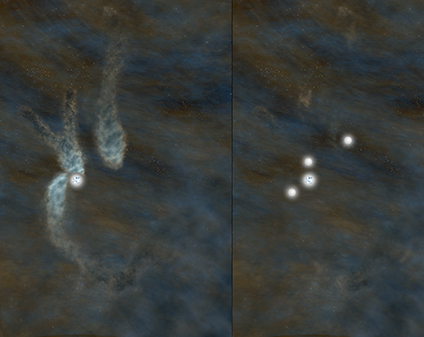
The image at left is not an impressionist painting, but a radio telescope view of a star-forming complex called B5, which lies about 800 light-years away from Earth. The entire cloud and its stars “vibrate” at radio frequencies that can be detected here on Earth, which gives us a chance to see the action that would normally be hidden from our inquiring telescopes.

Artist's conception of the B5 complex as seen today, left, and as it will appear as a multiple-star system in about 40,000 years, right. Credit: Bill Saxton, NRAO/AUI/NSF
Artist’s conception of the B5 complex as seen today, left, and as it will appear as a multiple-star system in about 40,000 years, right.
Credit: Bill Saxton, NRAO/AUI/NSF

The cloud has several hot “cores” where gas has been compressed by gravity so much that it has heated up and has started to glow. One area (the brightest one) in the blobs is a protostar—that is, a stellar core that will soon become hot enough to initiate fusion and become a star. The other hot cores will initiate fusion sometime in the next 40,000 years. That’s the speed of stellar starbirth folks: a few tens of thousands of years from blob of gas and dust to newborn star.

This radio “image” was made using data collected by three radio telescope installations: the Very Large Array in New Mexico, the James Clerk Maxwell Telescope in Hawai’i, and the Green Bank Telescope in Virginia. At least three of the “stars in forming” will be a multiple-star system in the future (shown in the artist’s concept at the right), and what astronomers learn about them at this stage in their birth will help them understand the very complex actions and processes that go on in interstellar clouds when the process of star formation begins.  This is particularly important because at least half of all star in the galaxy are in multiple-star systems, so understanding how they are born gives astronomers a good handle on a major portion of the star-forming activity in the Milky Way.

Exploring Science and the Cosmos

Spam prevention powered by Akismet