You’ve all heard of Yellowstone National Park, right? It’s in the northwestern part of Wyoming, and features geysers, mud pots and other manifestations of volcanic activity (but without the actual volcanic mountain). Well, scientists have been saying for a while that it could explode someday as a supervolcano because it has done so in the distant past. When that happens, people in several states (including mine) could be affected. So, they keep studying its ground movements, measuring quakes as they come, and keeping notes as the sleeping giant of a volcano dozes.
New research suggests the Eden Patera basin on Mars could have been formed by an explosive volcanic eruption, not the impact of a large object. Seen above, for the basin and surrounding area, higher elevations (reds and yellows) and lower elevations (blues and grays) are indicated. Credit: NASA/JPL/GSFC
It turns out that supervolcanoes aren’t limited to Earth. Mars may have one as well. Planetary scientists studying a region on the Red Planet called Eden Patera. It looks like just about any impact crater we’ve seen, but based on images taken from orbit, the area may well be a very ancient supervolcano. The last time it erupted, it may have blown a huge amount of magma (lava) rich in gases out to the surrounding landscape. As everything cooled, the volcano sank, leaving behind a depression similar to what we see at Yellowstone.
The Martian supervolcano may well have altered the Red Planet’s temperature for a while. It spewed huge amounts of ash and lava, much more than some of the other volcanoes on Mars. This material would have spread up through the atmosphere, and that would have blocked the sunlight and cooled things down.
So, how did planetary scientists happen to find this long-hidden supervolcano on Mars? It lies in a region that is pretty heavily cratered anyway, so people could have thought Eden Patera was just another impact crater. But, it some features that didn’t quite fit the requirements for such an event. It doesn’t have a raised rim as other impact craters do. Also, there’s no evidence of what scientists call “impact ejecta”. That’s literally rock ejected at the point of impact and scattered close by. So, it really didn’t suggest an impact origin for this depression in the Martian surface.
But, volcanism does create similar looking regions all the time. And, as it turns out, there could be more of these “hidden” volcanoes in the same region, suggesting a lot of activity in the distant past. If they get identified as real volcanoes, it could go a long way to explaining the existence of huge lava flows that haven’t yet been linked to any known volcano on Mars.
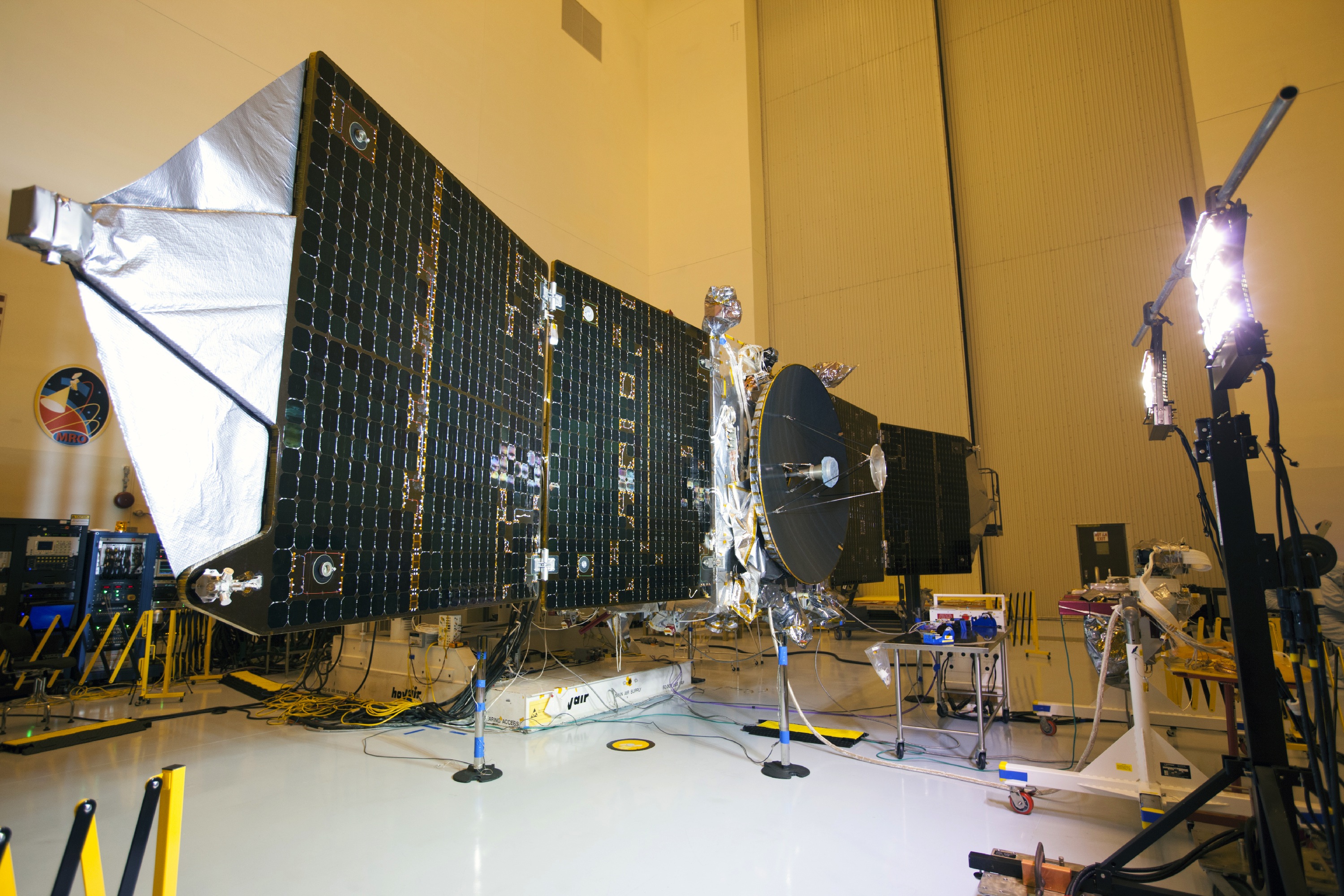
After a two-day shutdown, processing work will resume on the MAVEN spacecraft, shown here during an illumination test at NASA’s Kennedy Space Center. (Courtesy NASA/Kim Shiflett)
Update on MAVEN
In my last post I pointed out that the MAVEN mission was being shut down and processing halted due to the budget impasse instigated by the Republican-led House of Representatives in Washington, D.C. The mission was facing missing its launch window, thus wasting millions of dollars of valuable time and hardware if the team had to wait until 2016 to launch. Today, the MAVEN mission processors were allowed to go back to work to finish preps for MAVEN’s November launch. As it turns out, the mission is deemed “essential” since it will be part of the communication network from Mars to Earth, and any delay might leave us without a way to “talk” to other missions at Mars should one of the links that are already there suffer a failure. The resumption of work on the mission to get it ready for launch is a tremendous relief for the scientists and technical staff who have put years of their lives into the mission.
That’s the good news. The bad news is that those processors won’t be paid for their time. So, we should all be somewhat thankful that there ARE people in government service who take their jobs seriously and try to do what’s right.
They’re not much, but here are the first-ever images of a comet taken from Mars. Well, from Mars orbit, to be precise.
Comet ISON has seen from Mars Reconnaissance Orbiter. Courtesy NASA/JPL/University of Arizona
They were made on September 29, 2013, using data sent back from the HiRISE Camera onboard the Mars Reconnaissance Orbiter which is circling Mars on a mapping and imaging mission. The comet is just crossing the orbit of Mars and some observers are reporting a plasma tail growing (which happens for many comets).
Planetary scientists are still analyzing these images, but it’s easy for a layperson to see that Comet ISON is still fairly dim. While the image quality isn’t great as a result, what is shown here is enough to let the planetary science folks start working on figuring out how big the nucleus is. As the comet gets closer to the sun, its brightness will increase, and it may also become brighter as the stronger sunlight volatilizes the comet’s ices.
Comet ISON (officially known as C/2012 S1) may well be on its first pass through the inner solar system. It formed in the Oort Cloud, which begins outside the orbit of Neptune and stretches out for nearly a light-year away from the Sun. The next big milestone for the comet will be perihelion, which occurs on the 29th of November. Observers might be able to see it just before perihelion, but as I mentioned in my previous entry, if it survives its near-Sun passage, then it will be a fine sight in the skies starting around the 10th of December. For now, you actually need a telescope to view ISON, which is visible in the early morning hours. For comet-finding charts, check out Sky & Telescope and Astronomy magazines in the U.S., SkyNews in Canada, Astronomy Now in England, Ciel et Espace in France, Nuovo Orione in Italy, and Sterne und Weltraum in Germany. There are also many useful web sites beyond these to give you updates on the ISON.
Mission Delayed by Shutdown: Ya Canna Shut Down the Laws o’ Physics, Congress!
In other news about Mars, I was sad (and sort of mad) to see that the MAVEN mission to Mars is now threatened by the totally unnecessary government shutdown here in the U.S. This is an incredibly creative and much-needed mission to study the Mars atmosphere, and there’s NO reason why some politicians are gleeful about wasting the mission while they preach about how they want to clean up government “waste”. (Well, we all know that isn’t really the reason they’re having a tantrum, but that’s a topic for a political blog.)
Anyway, you can’t just launch to Mars anytime you want. You have to wait until the proper line-up of planetary orbits occurs so that you can send your mission on the shortest route. Those conditions are set by the laws of physics and orbital mechanics. What this means is, if the spacecraft doesn’t launch on time, it will have to wait until 2016. Here’s hoping that this impasse that the House of Representatives foisted on themselves will be fixed soon, because natural laws don’t care about a politician’s hissy fit. If you launch late, you lose. And you lose something infinitely more valuable than a politician’s inflated self-importance. You lose knowledge. You lose prestige. You lose a chance to do something to advance our science and knowledge.
A great many of these politicians do not understand or care about science, but through their childish antics, they ARE wasting money with their hissy-fit-caused shutdown of our government, which also extends to NASA and its contractors. This is in addition to wasting the time and efforts of thousands of dedicated people who just want their mission to get to Mars and return the data.
Stay tuned and let’s hope that MAVEN gets going on her trip to Mars soon!