
A Mystery Solved
More than fifty years ago a mathematician named Roy Kerr began looking at weird theoretical beasts called “black holes”. The idea of massive objects whose gravity is so high that nothing, not even light, can escape them, was not a new one in his time. But, they were considered theoretical, and nobody had observed one. There were a lot of people who though they didn’t really exist. Yet, there they were, theoretical objects that Albert Einstein and others suggested would have strange effects on space-time.

Einstein had written equations that described the properties of static masses (which black holes were considered at the time). He and others apparently thought they just hung there in space (if they existed at all). Some years later, astronomer Karl Schwarzschild found solutions to Einstein’s equations, but that didn’t bring black holes any closer to being discovered. That had to wait until we understood more about them.
We now know that black holes aren’t static. And, this is because Roy Kerr took another look at Einstein’s equations and worked with them under the assumption that black holes were actually rotating. He clarified that the size and shape of black holes could be described with two numbers: their masses and their rates of rotation. He worked with another scientist, Alfred Schild, and the two of them introduced the Kerr-Schild spacetime concept in 1965 that made it possible to understand (and look for) black holes. Not only did their work cover black holes, but it also applied to other massive (and weird) objects like neutron stars and compact binary star systems.
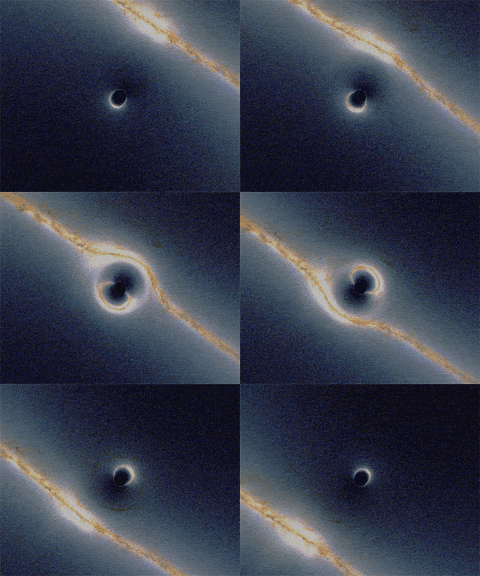
wiki/File:Black_hole_lensing_web.gif)
Today, we find black holes all over the place. They’re lurking in the hearts of galaxies as supermassive black holes. Some of these SMBHs (as they’re called) have the equivalent mass of millions or billions of Suns. Stellar-mass black holes (which form when very massive stars die in supernova explosions) exist throughout our galaxy. Understanding the effects of massive, rotating objects on nearby material allows astronomers to look for the radiation given off in the immediate vicinity of a black hole as interstellar material (gas, dust, stars) funnels in. A black hole also warps space-time, producing a lensing effect on light that passes near the cosmic beast.
Our own Milky Way Galaxy has a black hole at its heart. It’s called Sagittarius A*, and it contains about the same mass as four million Suns. Astronomers are still studying this black hole and others to understand how they form at the hearts of galaxies. There is evidence of a smaller black hole in the vicinity of Sagittarius A*. Could it be heading toward a union with the larger black hole? No one’s sure yet, but it’s an intriguing idea.
Today, some 50 years after Kerr’s work opened the door to black hole understanding, astronomers are honoring him at a conference in Warsaw, Poland called the 20th International Conference on General Relativity Theory and Gravitation. It’s a fitting honor for a man whose work solved, literally and figuratively, the mystery behind the once-theoretical black holes.
