
The End of the Kepler Mission?

Not Yet, but Things Don’t Look Good

NASA’s Kepler spacecraft, launched in 2009 to search out worlds around other stars, has likely reached the end of its current mission due to the failure of a critical component called a reaction wheel. The spacecraft has four of these wheels which help stabilize Kepler so that it can point steadily at its assigned area of the sky. One of them failed last year, and this new failure now leaves the spacecraft with only two reaction wheels — an unstable (to put it mildly) and unworkable situation. Still, the mission team hasn’t given up. Until the problem can be corrected (and that’s not looking good), the spacecraft is what they call “Thruster-controlled Safe Mode”.

It’s a very disheartening day for the Kepler mission team, since they and their spacecraft have been SO successful in discovering new worlds and giving us a new feel for the population of planets in the Milky Way Galaxy. Of course, the mission has always had an anticipated end point, but I think that planners were hoping that day would come when the spacecraft ran out of thruster fuel. There’s a few months’ worth of fuel left, so they will keep working to solve the problem with the wheel.

Of course, Kepler’s discoveries don’t end with these problems. In fact, some of the most exciting results are still to come. The spacecraft’s light sensors have gathered so much data about distant stars and possible planets that it will be years before it is all analyzed.  Hidden in that data are many more distant planets.  So, Kepler’s mission isn’t quite over until the last planet is wrung out of the data.  Still, the mission will lose out on at least two years of further observations of planet candidates, and that WILL be a loss to the community.

Bill Borucki — the principal investigator of the Kepler team, while echoing the team’s concerns about the spacecraft, has pointed out that the mission has been wildly successful. He ended up his statements today (at a NASA telecon) by saying, “It’s been a long journey to prove Kepler would work, see it get rejected time and time again, go back and improve the proposals, and put it all together. So today, I am delighted with all Kepler has accomplished. It gave us data like no other mission ever has. I’m just elated with what we’ve accomplished. I’m not feeling sorry at all.”
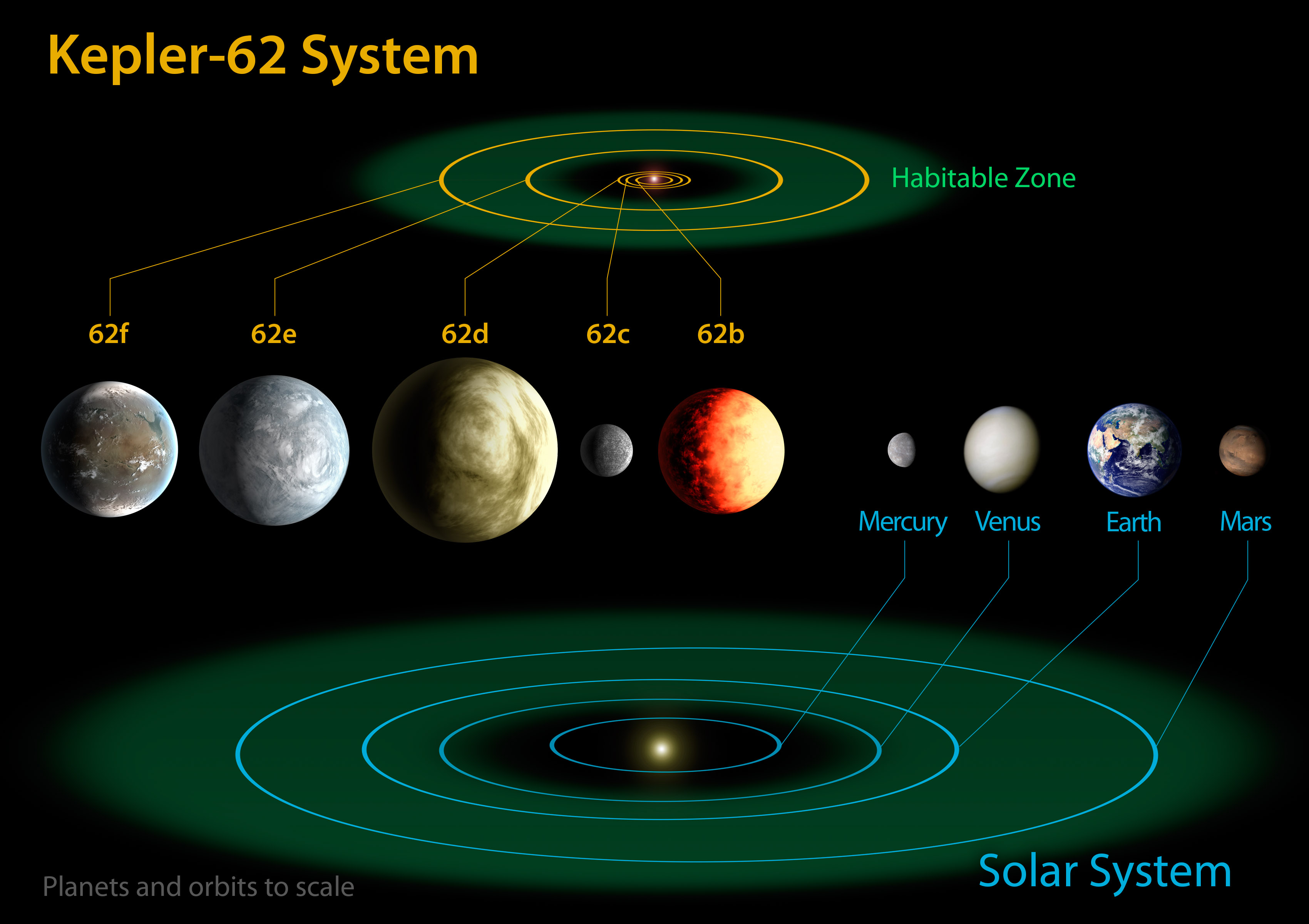
This diagram compares the planets of the inner solar system to the five planets of Kepler-62, a star just two thirds the size of the sun and only one fifth as bright. Two of the planets, Kepler-62f and Kepler-62e, lie in the star's habitable zone. The planets shown are artist's depictions. Credit: NASA/Ames/JPL-Caltech
This diagram compares the planets of the inner solar system to the five planets of Kepler-62, a star just two thirds the size of the sun and only one fifth as bright. Two of the planets, Kepler-62f and Kepler-62e, lie in the star’s habitable zone. The planets shown are artist’s depictions. Click to enlarge. Credit: NASA/Ames/JPL-Caltech
Kepler-69 System Diagram compared the planets of the inner solar system. Kepler-69c is the smallest planet yet found in the habitable zone of a G-type sun-like star. Its 242-day orbit resembles that of our neighboring planet Venus. Planet Kepler-69b orbits every 13 days, nowhere near the habitable zone. The Kepler-69 planets shown are artist's concepts. Click to enlarge.  Credit: NASA/Ames/JPL-Caltech.
Kepler-69 System Diagram. Kepler-69c is the smallest planet yet found in the habitable zone of a G-type sun-like star. Its 242-day orbit resembles that of planet Venus. Planet Kepler-69b orbits every 13 days, nowhere near the habitable zone. The planets shown are artist’s concepts. Click to enlarge.
Credit: NASA/Ames/JPL-Caltech.

So, what has Kepler accomplished?  If you  browse the mission website, you can sample some of the many types of worlds the spacecraft has discovered. It has found 2,740 planet candidates so far and 2,165 eclipsing binary stars. Of the planetary candidates, 132 are confirmed as actual planets. Each of those worlds have unique characteristics that give tantalizing clues about how they formed and the star systems they inhabit. Just as an example, the stars called Kepler 62 and 69, are two quite different stars.

Kepler 62 is not sunlike, and has several planets that are somewhat larger than Earth and one the size of Mars. When these planets were announced in April, John Grunsfeld, associate administrator of the Science Mission Directorate at NASA, hailed the mission’s critical success. “The Kepler spacecraft has certainly turned out to be a rock star of science,” he said.

Today, Grunsfeld was a bit less upbeat, but still asserted that the Kepler mission isn’t dead—yet. I echo his thoughts and hope that the Kepler mission team can find a way around the spacecraft’s reaction wheel woes. I am reminded of the same issues that Hubble Space Telescope faced with its faulty gyros, which could be fixed by astronaut visits. Kepler doesn’t have that option because it orbits too far from Earth for a rescue mission. That distant orbit is what made this fantastic mission of planetary discovery possible. I wish the Kepler team all the best in finding a way to  make the spacecraft work a while longer.


Using the Sky

Humans Have Done It Throughout History

I’m currently advising on a project in archaeoastronomy—the study of ancient astronomy. It’s an interesting topic, one that keeps cropping up as we find and visit places around the world with evidence that our ancestors used certain objects or landmarks as astronomical markers. Finding these means that even many thousands of years ago people were watching the sky and using it as a calendar and perhaps also in some kinds of cultural/religious/philosophical activities.

Of course, it’s hard to know exactly what the earliest people thought and said about the sky, since writing is a relatively recent invention in human history. They did cave paintings, they carved symbols on stone monuments, they aligned huge buildings (the Pyramids in Egypt come to mind) with specific positions of things in the sky, and they also created crude instruments to help them navigate using the stars. So, the discipline of archaeoastronomy really has its work cut out when a new site is uncovered. Not only do the positions of celestial objects come into play (particularly as they were in the time when the sites were built), but experts in sociology, paleontology, cultural anthropology, geology, and even chemistry and biology all can look at a site from their particular viewpoint and give us some insight into what function the site had, who used it, what it’s built from (field stone, stones from distant areas, etc.), and if there are burial sites nearby, who the people were who created these astronomy-related places.

Our planet has many such sites—the ones that come to mind immediately are places like Stonehenge, the Great Pyramid of Khufu in Egypt, the supernova painting in the U.S., and many others. It’s in our own interests as a species to preserve and understand these sites because they give us a lot of insight into our own history and cultural developments, and of course, the development of astronomy.

To that end, the United Nations UNESCO group and the International Astronomical Union have been working together to create an initiative called Astronomy and World Heritage. The aim of the initiative is to explore and reinforce the links between science and culture, particularly through the exploration of astronomy in the heritages of the world’s many cultures, particularly in the past.

You can get a good sense of the initiative from IAU’s own press release, where they state,

The three-year agreement commits UNESCO and the IAU to promote astronomical sites and provide states party to the World Heritage Convention with expertise, as they prepare nominations for locations to be included in the World Heritage List of exceptional sites that bear witness to major breakthroughs in the development of scientific knowledge. This is a step towards the recognition of the importance of the worldwide astronomical heritage, and its role in enriching lives throughout history and promoting international exchange.

UNESCO and the IAU signed a first memorandum within the framework of the thematic initiative on Astronomy and World Heritage in 2008. It was renewed in 2010 and implemented through close cooperation between UNESCO’s World Heritage Center and the IAU, sparking off a series of activities entitled Astronomy and World Heritage; across time and continents. It also led to the publication of a thematic work on astronomical heritage, compiled in cooperation with the International Council on Monuments and Sites (ICOMOS), to the creation of a web portal (http://www2.astronomicalheritage.net) on the history of astronomical heritage and to the organization of numerous seminars and conferences on the subject.”

When you stop to think about all the humans who have walked this planet, and consider how much astronomy has influenced cultural growth—from navigation to cultural rituals to science—it is tremendously important to seek out and preserve sites where humans long ago first set their eyes on the skies and used what they saw to survive and thrive.

Exploring Science and the Cosmos

Spam prevention powered by Akismet