
Freedom to do Astronomy

Stars and Veterans

Poppies for Armistice Day

My dad is a military veteran. He fought in the U.S. Army in the Korean War and was one of the lucky ones to come back alive. He was also the person who first got me started in astronomy, taking me out to look at the stars when I was probably just barely old enough to know what those lights in the sky were. He’s always been fascinated with space and astronomy and has a couple of telescopes and I don’t know how many books about the subjects. I can proudly say that if it wasn’t for him, as well as my mom’s push for me to get good grades (which I didn’t always do) and be a reader (which I DID do), my own interest in astronomy might never have bloomed.

Stars for Veterans Day

So, this one’s for you, Daddy, on Veteran’s Day—for coming home and making sure that I got bit by the star bug, and for being such a star-hopper yourself!

Veteran’s Day is the U.S. variant on celebrations like Armistice Day or Remembrance Day in other countries. It’s a time to thank the men and women who are in the armed services who have served their countries in times of peace AND war. Regardless of how you feel about war, soldiers (whether your own country’s or those of other countries), the day is there to remember their service and sacrifices. It’s a very human holiday and I can’t think of any country in the world that doesn’t owe at least some measure of thanks to those who served.

There’s an interesting connection between war and astronomy. In the really olden days, war planners consulted the stars for propitious times to do battle. Why, they even had Mars—their very own god of war. Later on, the development of the telescope (while not strictly a military invention) allowed ship captains to spy out their adversaries at sea, and land-bound armies to see their enemies coming long before battle.

Today’s astronomers (vet and non-vet alike) benefit from instruments that were developed for military use. These days, such things as adaptive optics and remote sensing are giving us unprecedented views of the cosmos. Those technologies were largely developed for military use (either during wartime or for “intelligence” purposes).

I kind of like to think that these technologies are transcending their warlike roots. At first they’re used by people who are awarded stars for bravery and valor. Now, they’re delivering the stars to everyone, a graceful and wonderful Veteran’s Day/Remembrance Day gift.

Daddy, Pete Petersen,  Grandpa Collins, Rollie, Tony and all the others who served — THANK YOU!
Lighting up the Night

Would Aliens Do That?

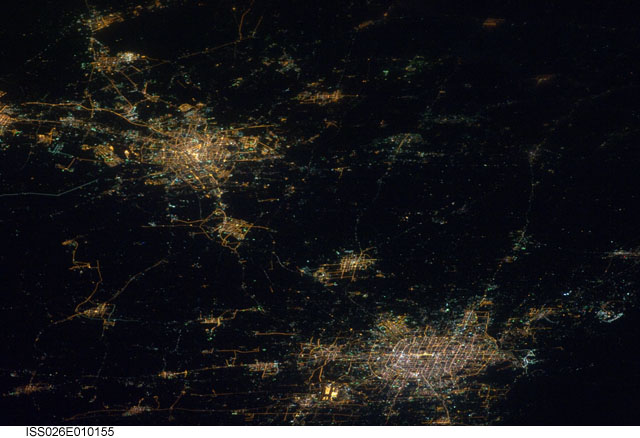
A nighttime view of Beijing's city lights splashing out to space. Earth's night-time side is aglow with light splashed carelessly to space. Image courtesy of the Image Science & Analysis Laboratory, NASA Johnson Space Center

We humans spend a lot of money turning our lights on at night.  We light up our houses, our parking lots, our highways, our high-rise buildings—you name it. If we build it, we light it up.  You don’t have to go to space to know that we have a love affair with illumination. That’s because light pollution is a constant on every continent. But, somehow, it seems more obvious when you see it from space.

Astronauts living and working on orbit since the dawn of the Space Age have shown us in countless images how Earth’s brightly lit cities glitter like diamonds on the night-time face of our planet. To any visitor from another planet coming to visit us, those lights have a simple message: here is a civilization that is so wealthy that it can spend money lighting up the night-time sky. Here are beings who want to advertise their presence to the cosmos.  Here is evidence of intelligent life!

Actually, our alien visitors wouldn’t have to be all that close to detect our light pollution and make some guesses about our civilization. If they had powerful enough telescopes, observers on distant planets could simply watch Earth as we turn our lights on at night. Our planet’s dark side could be detectable with a powerful enough telescope and the right kind of observational techniques.

Will alien civilizations splash their lights to space? If so, Harvard astronomers think we could use those lights to detect their existence. Credit: David A. Aguilar (CfA)

The idea is not so farfetched as it sounds. Two researchers representing Harvard University’s Center for Astrophysics and Princeton University have suggested that Earth-bound astronomers use that exact method to search for life on other planets beyond our solar system.  Those changes, if astronomers can spot them, could be due to artificial illumination, and that would signify the existence of intelligent life on distant worlds.  (You can read more about the research behind the idea here).

It’s an intriguing twist on the search for extraterrestrial civilizations, and with the pace of advancements in telescope technology, such research is not that far off in our future.  But, I have to wonder: would every civilization be so wasteful of its resources by lighting up the sky?  I suppose we’ll find that out when we spot those distant worlds and spy out their cities and roadways and parking lots and other places they choose to illuminate, just as we do here on Earth.

Want to see more images of Earth at night? Browse through the Earth from Space website. and you’ll see our planet in all its glory, as witnessed through the eyes and cameras of Earth-orbiting astronauts.

Exploring Science and the Cosmos

Spam prevention powered by Akismet