
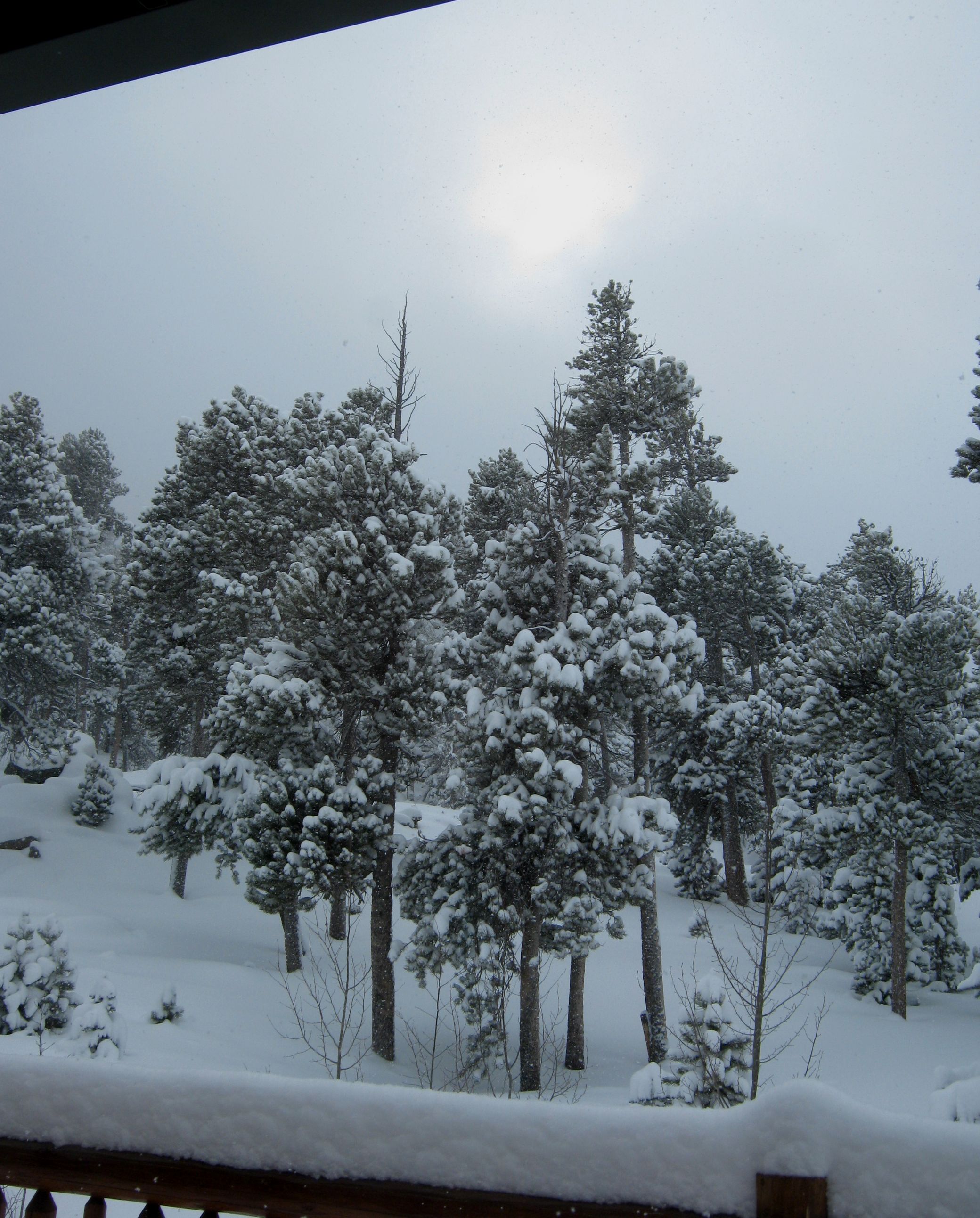
The Sun in Stereo

Two Perspectives

The is the Sun from my place on February 6, 2011.

Okay, everybody and his or her cat is jumping on this story about the Sun today — and for several good reasons:  1)  it’s great science about our nearest star and 2) it’s freaking cold out throughout much of the U.S. (and probably the rest of the Northern Hemisphere, and some of us will take any Sun we can get.

We get irrationally attached to that bright thing in the sky during the cold winter months — it’s our lifeline, the source of our warmth, and the hottest thing in the solar system. Small wonder we look for it after a few days of snow and when it shows up, some of us go outside and marvel at it (and the snowplows, who come, tank-like, to liberate us) after the storms.

But, there’s another perspective we can take on the Sun — and that’s our study of it as a star.  Sure, we all know it’s a giant sphere of superheated gases, plasmas if you will. And that heat is what powers the solar system, warms our planet, and bathes us in light.

That scientific perspective is what fuels today’s release of the STEREO mission’s first (darned-near-180-degree) view of the Sun. It shows us our nearest star in virtual stereo quality, as seen by two spacecraft that are studying it from opposite sites of Earth’s  orbit.
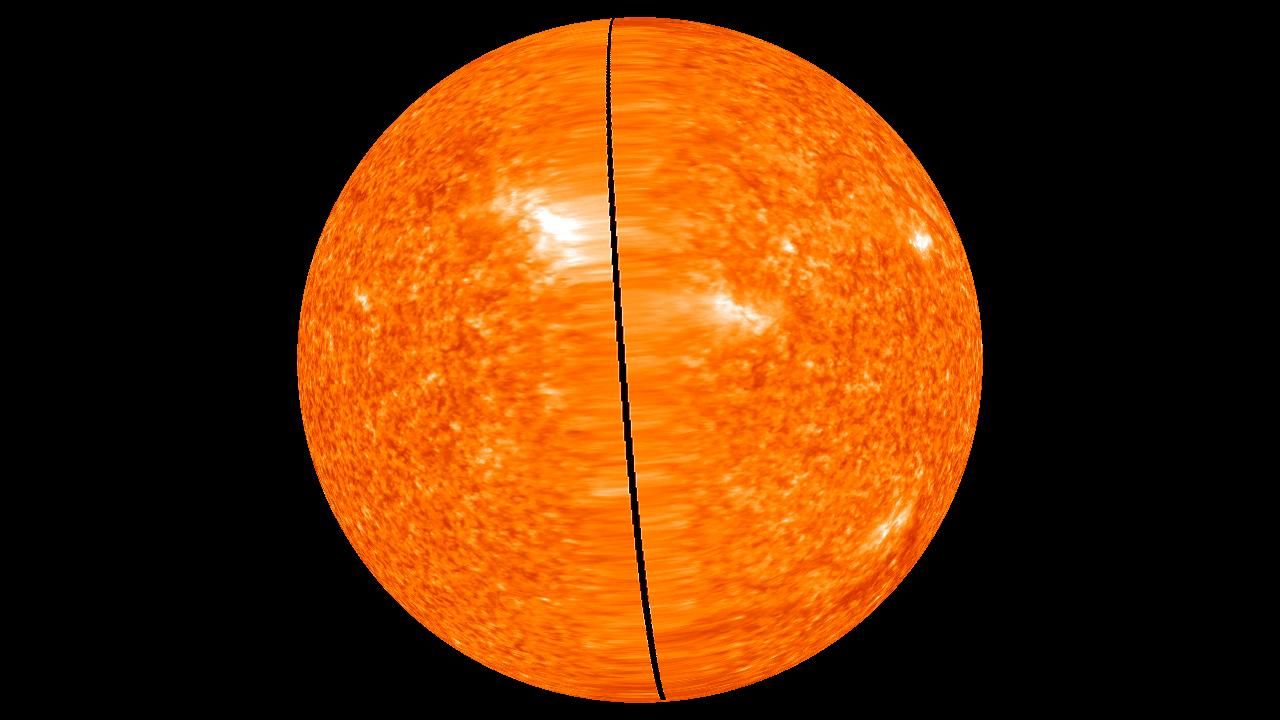
Latest image of the far side of the Sun based on high resolution STEREO data, taken on February 2, 2011 at 23:56 UT when there was still a small gap between the STEREO Ahead and Behind data. This gap will start to close on February 6, 2011, when the spacecraft achieve 180 degree separation, and will completely close over the next several days. Credit: NASA (Click to luxuriate.)

In the next few days, the STEREO spacecraft will be at a true 180 degrees apart (the images shown here were taken when the spacecraft were 179.7 degrees apart, and closing in on their final positions fast).

The image we see here is how STEREO sees the far side of the Sun. The first thing you notice is that line of black — that’s a data gap that will be closed when the two spacecraft are in their final positions. The true beauty of STEREO’s work is that it will allow scientists to study the Sun in true 3D.  It’s a big step forward for solar physics because 3D shows us that the Sun truly is a sphere of hot plasma, and that plasma gets woven and threaded through some incredibly intricate and ever-changing magnetic fields.

The action of those magnetic fields powers the incredible activity we see on the “surface” of the Sun and in it s superheated atmosphere. STEREO’s images and data are finally giving solar physicists the ability to fly around the Sun and study it year-round.
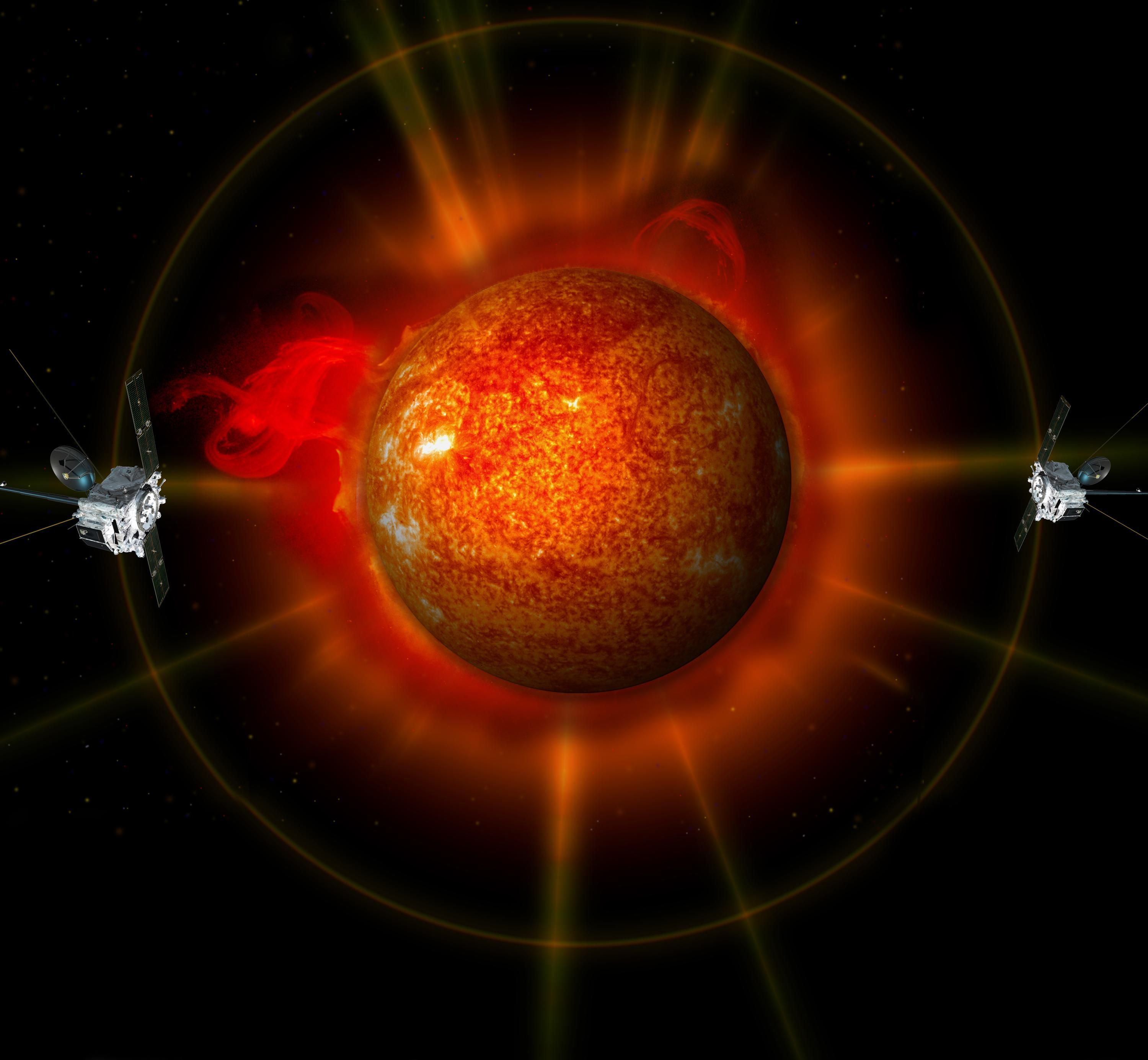
The STEREO spacecraft configuration. Courtesy NASA.

This is because the two spacecraft are at two separate points along Earth’s orbit and they virtually DO fly around the Sun over the course of a year, giving us a long-term view of our star and its activity.

Using STEREO, it is now possible to follow the evolution of an active sunspot or flare region on the opposite side of the Sun from Earth, all by using the twin spacecrafts’ abilities to see the Sun in both hemispheres. Scientists will be able to track that active region before it rotates around to face us — giving us plenty of time to take action if the activity is going to mess with our satellites, the ISS,  and power grids and telecommunications systems.

In fact, the National Oceanic and Atmospheric Administration’s Space Environment Laboratory is using data from the STEREO spacecraft to make ever-more-accurate models of outbursts from the Sun called “coronal mass ejections”. These explosions belch out huge masses of charged particles out from the Sun. They create what’s known as “space weather” — changes in the geomagnetic environment in near-Earth space. When those clouds of charged particles hit our planet’s magnetic field, the result can be as benign as a gorgeous display of northern or southern lights, or as disastrous as a power grid failure or fried satellite electronics. So, STEREO will be a huge help in predicting solar storms and helping us avoid the worst consequences of them.

Check out the STEREO web page for more images and cool videos.  And, keep following this story — there’s a LOT more we’re going to learn about the Sun from the STEREO perspective!

Finally, here’s a big shout-out to my old friend and grad school office “roomie”, Dr. Lika Guhathakurta. She’s the STEREO program scientist at NASA and I imagine she’s just thrilled with the data she and her team are seeing.  Hey Lika!  This one’s for you!

Getting to Know the First Stars

They Lived Fast, Died Young, but Weren’t Lonely

I’ve long been fascinated with the earliest objects in the universe. And, we live in a time of astronomical discovery and research when scientists are getting closer to “seeing” the earliest objects in the cosmos and understanding how they formed. No they aren’t actually “seeing” the first stars in high-resolution. But, they can use what they do know about the early universe — including the abundances of the elements hydrogen and helium — to come up with very good computer simulations of what was happening back then. Those simulations are causing them to rethink the idea that the first stars were massive, lonely giants.

Let’s start at the beginning… the REAL beginning.

The standard story of the universe starts with the Big Bang — an event that heralded the creation and expansion of the universe.  A few million years after this event, the universe was not something that we could detect with our eyes (if we’d been there at the time).  It was a smooth, uniform mass of material expanding outward.  There were a few fluctuations (variations) in the newborn universe’s temperature and density (that is, the amount of material it had and how it was distributed). If you were there, you would sense only a dark existence — a time called the “Cosmic Dark Ages”, where the “stuff” of stars and galaxies was still a sort of “amorphous” blob. The only radiation that existed was shifted by the expansion of this new universe into wavelengths was what we can detect from OUR point in time as infrared radiation.

That changed when the first stars coalesced out of this “stuff” and began to shine. They gave off ultraviolet and visible light, lighting up the universe. They ushered in a time called the “Epoch of Reionization”.  To put it simply, the infant universe got “lit up” by the first stars.

So, what were those first stars like?  For a long time, astronomers have theorized that they were supermassive, hot, and lonely — meaning they were not clustered together close together in space. However, that picture is changing slightly.

According to some very high-end computer simulations created by astronomers at the University of Texas at Austin and the Center of Astronomy at Heidelberg University, the Max-Planck Institute for Astrophysics in Garching (Germany), those early stars may actually have formed with stellar companions in their protostellar disks.

What’s a protostellar disk?  It’s the nebulous cloud of gas that is set in motion as a giant swirling disk. Eventually the central region in the disk gets hot and dense enough that the nuclear reactions that power stars switch on. The gravitational pull of the stuff in the center wants to suck in more material, but the heat of the stuff in the center is trying to escape. This is true of stars being born today and it was true of the births of the first stars.

A supercomputer simulation of the birth of a primordial star. A spiral pattern forms inside the disk surrounding the star, leading to enhancements in density. One of these density perturbations is large enough to trigger the formation of a secondary protostar. Distances are measured in astronomical units (AU), which is the distance between Earth and our Sun. Credit: Clark, Glover, Smith, Greif, Klessen, Bromm (Univ.of Heidelberg, UT Austin); Texas Advanced Computing Center

However, in some senses, primordial star formation was a very different process. To be sure — there was still that push-and-pull action between the gravitational attraction pulling the star-forming gas together, and thermal energy trying to push it apart. But, for the early stars, things were a bit different during the formation process.

As gravity squeezed the material, the gas heated up. For gravity to win, the gas needed to “lose” the extra heat produced during the collapse. This was more difficult for gas in the early universe than in galaxies like our Milky Way today. This is because when the universe was first formed, its gas did not contain elements such as carbon or oxygen, which cool the gas and make it easier to collapse.  Stars that are born “today” in clouds of gas and dust are rich in the “cooling” elements.

This “lack of cooling elements” was one reason give why astronomers thought thought that primordial stars were solitary massive objects. However, the calculations by the teams in the U.S. and Germany demonstrate that this simple picture needs considerable revision due to the physics of the disks that build up around primordial stars as they form.

We know that the disk around the young Sun that fragmented to build up the planets in our solar system. As it turns out, the accretion disks that formed around the first stars were also found to be highly susceptible to fragmentation.  But, instead of forming planets — since the heavy materials to form worlds didn’t exist — they formed additional stars.

So, instead of forming in isolation as massive single stars, some of the first stars seemed to have formed as members of multiple stellar systems, with separations as small as the distance between Earth and the Sun.  At the end of the birth process for these early stars, it’s far more likely that a massive double star would emerge.  The pair would produce high-energy photons. As they aged, they would produce some of  the first heavy chemical elements — like carbon and nitrogen.

Of course, there were also massive singleton stars formed in the early universe. These super-supermassive stars weren’t destined to live long — similar to massive stars that exist today. They spent their short lives creating heavier and heavier elements in their cores — and just as with supernovae today, the first massive stars that died as supernovae back in the early days of the universe spread those heavy elements out to the expanding cosmos. Those elements are crucial for the formation of the next generations of stars — and planets — and life. So, think of the first stars as instigators of the ultimate recycling processing in the universe.

The binary nature of the first stars opens up exciting possibilities for detecting them. Astronomers can search them out in  hyper-energetic gamma-ray bursts, or through the strong x-ray radiation they give off as they evolve and die.

The search for and study of the first stars is another major step in understanding just when the Cosmic Dark Ages ended and when actual “First Light” commenced with the births of the earliest stellar objects.

There’s more information about this first stars simulation at the McDonald Obeervatory website.

Exploring Science and the Cosmos

Spam prevention powered by Akismet