The Atomic Bomb of the Middle Ages

or, The Physics of Punkin’ Chunkin’

What could be more geeky than going out on a beautiful fall afternoon and watching some guys do physics? Not much, I’ll admit. But, that’s what we did this weekend and by golly, we enjoyed watching guys hurl, just as folks have been doing ever since the Middle Ages, when flinging rocks at your enemy’s castle was the state of the art in warfare. Only this time it’s more peaceable — the guys we watched were hurling pumpkins more than 2,000 feet at a pop.

The trebuchet at Yankee Siege hurled a pumpkin more than 2,000 feet on October 12, 2008.

The occasion was the Punkin Chunkin practice shooting at Yankee Siege in Greenville, New Hampshire. They don’t hurl with their hands — they use a trebuchet.  Those of you who are Northern Exposure fans may recall that in one episode they hurled a piano into a creek using a trebuchet.  Those of you who are physics fans have probably already created your own trebuchet and flung stuff with it.  You can learn  more about trebuchets at Trebuchet.com, where they have all kinds of discussions about hurling stuff, feature some books and, of course, simulators and desktop trebuchets for sale.

So, aside from howling and stamping and laughing and clapping as these guys wound up their siege engine and hurl a pumpkin almost half a mile, what’s the deal with these things? Why the fascination?

A trebuchet is basically the oldest projectile weapon machine in the world. It was used in the Middle Ages to strike fear into the hearts of opponents, and it was fairly easy to build with the materials at hand.  All you needed was a sling to hold the load (your basic rock as a weapon) and a structure that used a lever arm to hurl the rock.

The lever and swing principle behind the trebuchet. Courtesy of Thinkquest.org.

A lever arm works by sticking something on one end of a stick or board and then dropping something heavy on or from the other end (a counter-weight) .  The projectile load goes flying off, hopefully toward your opponent. It’s like a see-saw, only a lot bigger and more dangerous and ‘way more complex, as you can see by the picture of Yankee Siege’s trebuchet.

It’s physics, man.  And, when you watch them wind it up, get it loaded, and then let some little kids tug on the rope that launches the trebuchet, it’s a thing of beauty to watch that regulation pumpkin soar into the air in a perfect arc.  People stand up and cheer and hoot and holler.

Maybe you don’ t have a trebuchet in your neck of the woods, but that’s no reason not to play with one and do a little physics at the same time.  Take the Treb Challenge by building your own virtual trebuchet and flinging some weight around.  And remember, as they say at The Hurl, it’s not what you hurl, but the hurl itself that matters!

********
Registered to vote?

Fall Colors

Autumn Leaves and Bright Stars

Maple tree colors
Maple tree colors

We took a break yesterday from all the hustle and bustle of work, politics, and other stuff that occupies our lives and drove around the countryside, looking at the colors of the leaves on the trees.

It wasn’t the only reason we were out and about; some friends are on travel and we agreed to watch after their pets for a few days. It just so happens some gorgeous forests lie between here and there, so the ride was doubly worth it.  Before we left, I snapped a pic of the maple tree in front of our house. It’s just exploding in yellows and oranges now.  It’s beautiful for a few days and then, with a “whoom” you can almost hear, it loses all its leaves and we have to look at bare branches for about six months.

Albireo (courtesy Wikipedia and Hunter Wilson)

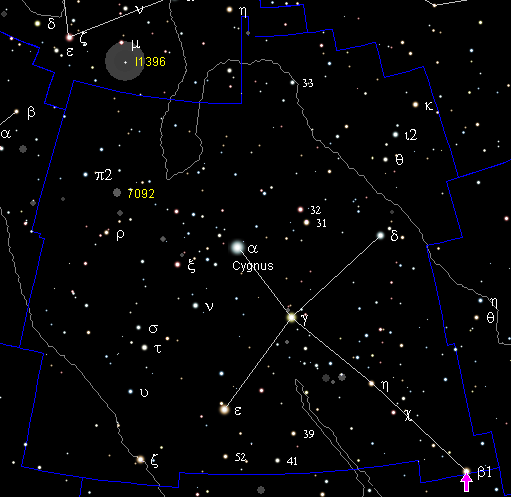
Now, trees aren’t the only colorful things out there this time of year. There’s a bright star called Albireo (or β (beta) Cygni for those of you who prefer the “proper” nomenclature). Those of us in the northern hemisphere mid-latitudes see it nearly overhead this time of year (around 8 p.m.). It’s the bottom star of the constellation Cynus the Swan. (Need a star chart?  Go here or here.)

If you look at Albireo with the naked eye, it looks like a shiny whitish star. As it should. But, look at it through a telescope (say  6″ or 8″ (15 to 20 cm)), and suddenly Albireo turns into a colorful double star. Albireo A is somewhat golden-colored while Albireo B looks bluish-green… not quite the brightest fall colors, but pretty striking even so!

Star chart for Cygnus; arrow points out Albireo. Courtesy Wikipedia.

If you’ve got clear skies and can see the bottom star of Cygnus from where you live, go check it out!  Even without a telescope, the autumn night sky looks pretty cool.  You’ll be able to spot the “cross” part of Cygnus pretty easily, and Albireo is the star at the bottom. (You shouldn’t see an arrow in the sky. If you do, we need to talk.)

While you’re out (and if it’s dark enough where you are), marvel at the Milky Way Galaxy. Cygnus is flying north through the plane of our galaxy. If you look at the MWG (as we like to call it in shorthand in astronomy circles), you should notice thousands of stars as a sort of “backdrop” to Cygnus.

Wanna know more about the autumn sky?  Why not check out your local planetarium and see if they’re giving an Autumn Skies show?  Check it out!

********

Registered to vote?

Exploring Science and the Cosmos

Spam prevention powered by Akismet