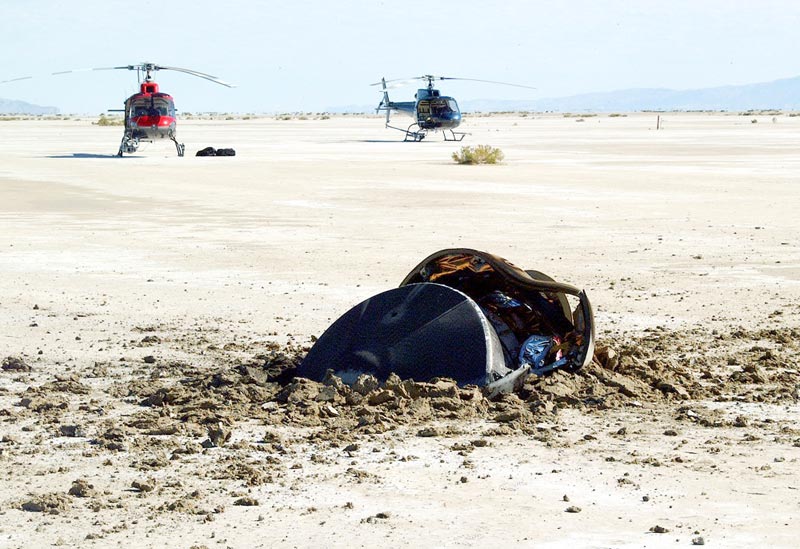
Last week wasn’t a great week for the scientists on the Genesis mission. The spacecraft, which has performed quite well throughout the program, has been collecting samples of the solar wind and storing them on delicate chips for study by scientists here on Earth. The collecting capsule returned on Wednesday, but due to a parachute malfunction, it crashed to Earth instead of wafting gently down and being picked up by a stunt pilot flying a specially equipped helicopter.
It was pretty dismaying to watch the little canister come hurtling down and smack into the Utah desert. When I saw the first closeups of it buried in the dirt, I figured “Well, so much for the science.” The capsule was cracked open, you could see its innards through a couple of good-sized holes, and it was obvious that the inside had been contaminated with dirt. But, I also knew that the scientists could more than likely recover some science. How much they would get was (and still remains) an open question.
As it turns out, while many of the wafers containing the captured particles of the solar wind are broken, but as researchers pick through the pieces, they are finding that there’s more for them to work with than the landing might have suggested.
I think that’s pretty cool. Despite the smash-up end to the mission, it appears that the scientists got a lucky break. They did plan the capsule to be pretty robust—that is, strong enough to not break into complete smithereens if a crash occurred. They CAN subtract data about the contamination out of the data they gather from the chips. In all likelihood, it will be enough to help them understand the role of oxygen in the formation of our solar system, and how nitrogen played a part in the formation of atmospheres like Earth’s. So, as my grandfather used to say,”them’s the breaks” but in this case, at least it wasn’t broken so badly that scientists were left with nothing to study.
So, why did I become a science writer? Earlier I wrote about what started me on the road to writing planetarium shows. But those weren’t my first published stories about science. The roots of my fascination with space and astronomy stretch back to my early childhood. I remember my dad taking me out to see the stars, which kindled something in me. We had books around with pictures of Saturn, which to me seemed like the strangest place in the universe. Later on, after the first successful space missions, I was mad to be an astronaut. Until I could grow up to become one (a goal I’ve not yet attained), we played games like “Mars Exploration”—featuring an alfalfa field, a cardboard box, and the active imaginations of several little girls and long afternoons of playtime in which to explore. (By the way, that game eventually became part of a planetarium show I wrote for the National Air and Space Museum’s Einstein Planetarium in 1996).
Valles Marineris image from European Space Agency
So, Mars was probably the first world I “explored” and it’s been with me ever since. My science writing career began, however, when I covered the Voyager/Saturn encounter in 1981 for my employer at the time, The Denver Post. I spent a week at JPL in Pasadena, California, mingling with other science writers, meeting the mission scientists, and marveling at the amazing images flowing back from the distant spacecraft and its planetary target.
But, Mars crept back into my consciousness a couple of years later. In 1984 was invited to attend a meeting called “The Case for Mars”—a sort of underground gathering of scientists who wanted to spur exploration of Mars. The Red Planet had sort of been “off the table” since the Viking missions and the NASA budget cuts made it look less like a target. So, these scientists wanted to keep Mars exploration on the table. For several days I attended meetings and talks that discussed some of the forerunners of recent Mars missions: Pathfinder, Mars Global Surveyor, and the rovers. The goal was to layout the steps toward a manned mission to Mars sometime early in the 21st century.
That experience, and attendance at other Case For Mars meetings sent me back to school, ostensibly to study planetary science. I spent several years at the University of Colorado soaking up courses in astronomy, space science, and planetary science. All the while, I kept writing, took up lecturing at the planetarium, and worked as a comet researcher in one of the University’s labs. Eventually I also joined an HST instrument team, and wrote my first book about HST with co-author Jack Brandt.
Finally I decided it was time for graduate school, and then I ran smack into a dilemma I thought I’d never encounter: what to study. I really wanted to study astrophysics or planetary science, but the job market was discouraging, as were the prospects of getting into graduate school in those areas. But, even if jobs had been waiting and I could have chosen any program, there was another issue: I was really enjoying the life of a science writer. It allowed me to explore any issues I wanted, ask any questions I wanted, and get a panoramic view of the science areas that interested me. It was a tough choice: specialize in science or specialize in writing about science.
Ultimately, I chose to work toward a masters’ degree in science journalism. I got to keep my research job AND I could explore better ways to communicate science. It was perfect and I loved every minute of the intellectual challenges my situation presented. And, I have always held out the possibility that someday I’d go back to school and take that doctorate in planetary science—fulfilling that desire to explore Mars, in mind if not in body.
So, here I am, a science writer, pursuing understanding in the areas that interest me most, and sharing that understanding with others. It’s a fun ride!