

X-rays From Black Holes Reveal Growth Over Time
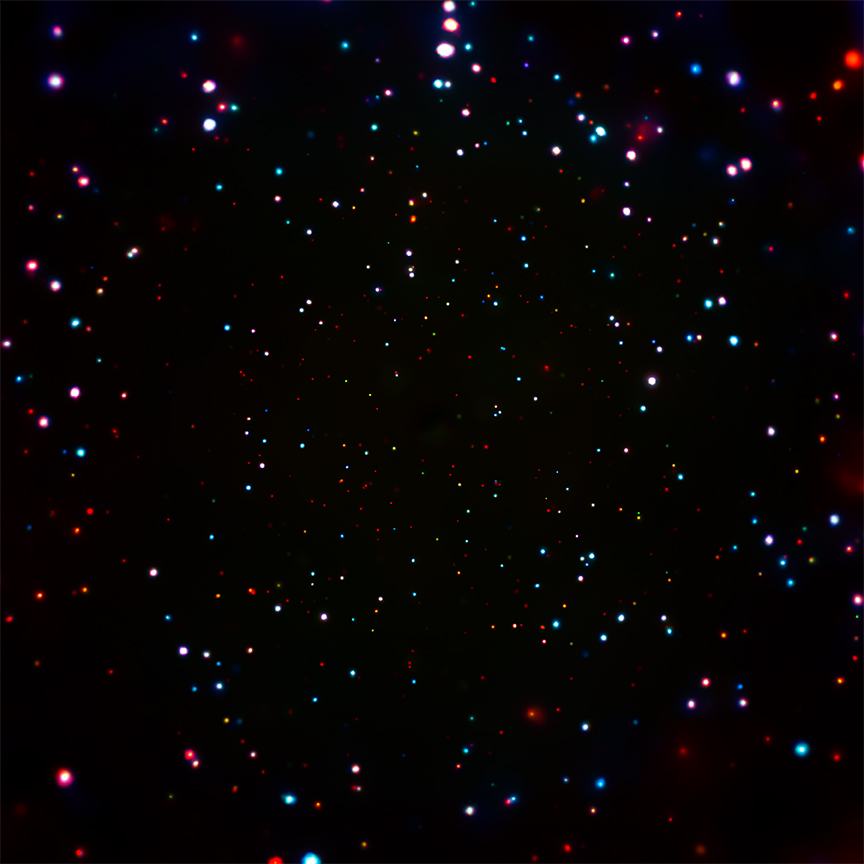
What do you think you could find if you pointed an extremely sensitive x-ray telescope toward a distant part of the sky for nearly three weeks? That’s the challenge that Chandra X-ray Telescope scientists took on. The result is the image on the left.
This highly detailed view was produced by the observatory and gives astronomers the best look yet at the growth of black holes over billions of years beginning soon after the Big Bang.
This is the deepest x-ray image ever obtained. It comes from what is known as the Chandra Deep Field-South study. The central region of the image contains the highest concentration of supermassive black holes ever seen. The observations, which began in 1999 and continued into 2016, totaled more than 7 million seconds of telescope time. What those 11.5 weeks of total time covers an astonishing depth of study that stretches back through 12.5 billion years of time.
Using X-rays to Trace Black Holes
The image explores the earliest days of black holes in the universe. About 70% of the objects in the new image are supermassive black holes and it’s so rich that it allows scientists to see change over time.
How can black holes emit x-rays? Gas falling towards these black holes becomes much hotter as it approaches the event horizon/ That superheating results in bright x-ray emission. And, tracing those emissions is what gives astronomers new insights about the types and sizes of black holes nurtured by the early cosmos and their rates of growth.
How Does the Black Hole Garden Grow?
The growth of black holes in the early universe is a huge topic of scientific interest. Deep x-ray studies give astronomers a good idea about their evolution back “in the day”. It turns out that black holes grew mostly in bursts rather than slowly gobbling up material over time to get bigger in the epoch just after the Big Bang.
The x-ray emissions from these massive objects also help astronomers understand something about the “seeds” they grew from. It turns out that they may have started out with masses about 10,000 to 100,000 times that of the Sun, rahter than as really small black holes of just a few hundreds of solar masses. Moreover, they appear to have grown very rapidly to more than a billion solar masses very early on.
Black Holes as Far as They Can “See”
The researchers also detected x-rays from massive galaxies at distances up to about 12.5 billion light-years from Earth. Most of the x-ray emission from these distant galaxies likely comes from large collections of stellar-mass black holes within them. They formed from the collapse of massive stars and typically weigh a few to few dozen times the mass of the Sun.
How They Observed The X-Ray Deep Field
The team combined Chandra x-ray data with very deep Hubble Space Telescope data over the same patch of sky. They studied x-ray emission from more than 2,000 galaxies identified by Hubble that are located between about 12 and 13 billion light-years from Earth.
What’s Next?
Chandra and future x-ray observatories will be needed to provide a definite solution to the mystery of just how supermassive black holes grew to reach their current massive states. Now that the deep field has shown the way, astronomers will take much larger samples of distant galaxies using the James Webb Space Telescope. That will give even more targets for x-ray sensitive observatories to observe further out in space and back in time.


 , which looks like a good read!