
The Radio Sky Through Human Eyes

Check out the MWA Sky

The sky as seen by MWA
Title screen from a video about MWA.

Interested in the radio sky at low frequencies?  Then,check out the Murchison Wide-field Array (MWA). A few years ago, we worked on a video about the MWA, located in the outback of Western Australia. The video was created for the MIT Haystack Observatory, which was involved with the project. We interviewed Colin Lonsdale, who is director of Haystack, and created a short explainer about the observatory.  It was a fun project and I’ve kept tabs on the MWA’s progress ever since.

A Sky in Radio Technicolor
radio sky
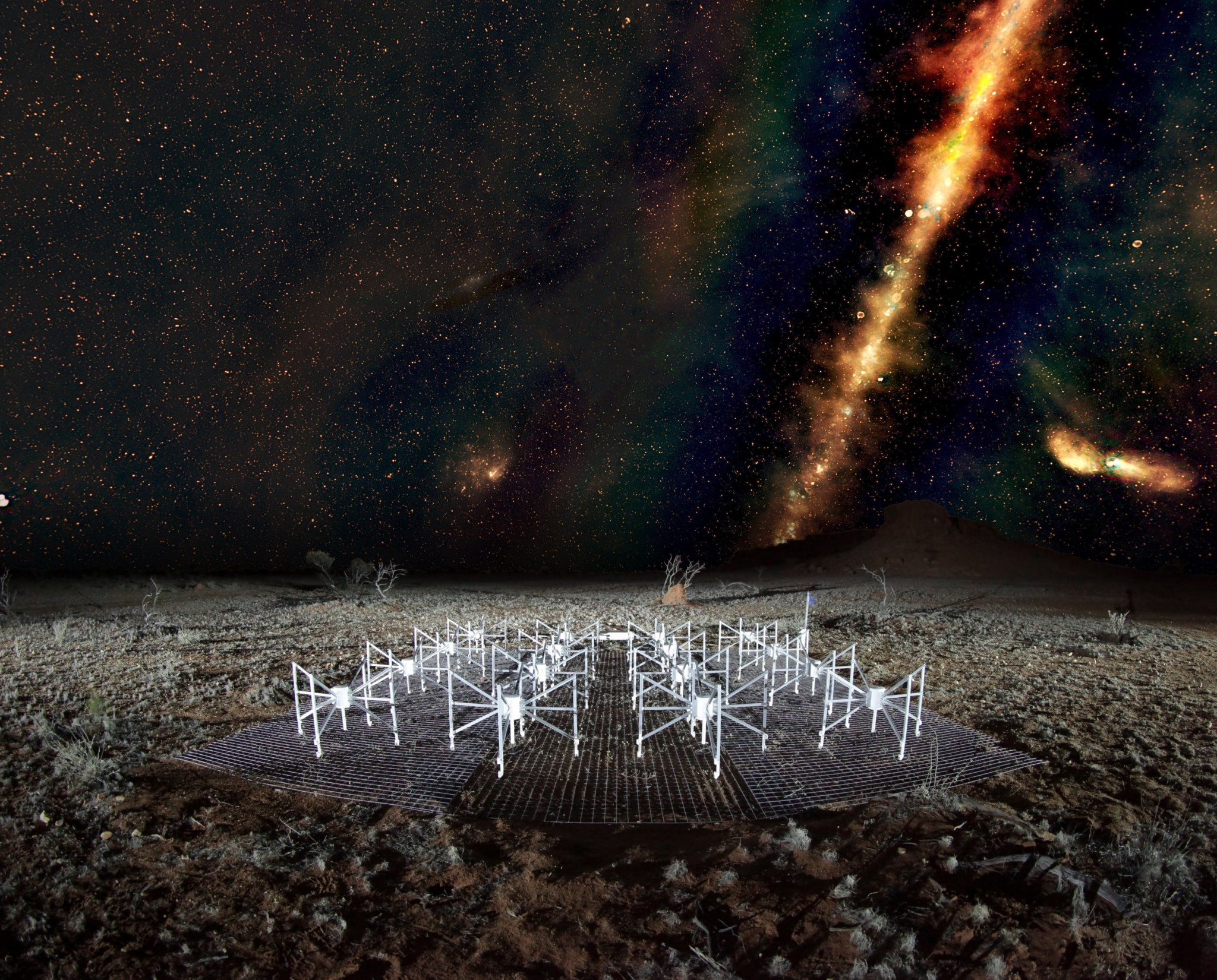
The MWA sky, as seen by the GLEAM survey.

Recently the folks who run MWA released an image from a sky survey they’ve made called GLEAM (which stands for GaLactic and Extragalactic All-sky MWA). The combined MWA receivers scanned the sky at frequencies between 70 and 230 MHz. These are very low-frequency waves that can be easily disrupted by TV and radio signals (among others). So, MWA is located literally in the middle of nowhere with a fine view of the sky.  In the image they released, red denotes the lowest frequencies received, green is the middle of the range, and blue indicates the highest ones. This is what gives the image its ‘technicolor’ look. That works for our eyes, which can only see three primary colors.  MWA actually detects more than 20 colors.

What Does MWA “See”?

Among the objects that MWA can detect in its frequency bands are ancient supernova explosions and emissions from distant black holes. They are just a few of the types of celestial sites that lie in the 24,402 square degrees of sky that the MWA covered in the survey. In that region, there are more than 307,000 radio sources.   If you’re interested in the full paper from the survey team, it’s available here and gives all the details about the survey and data reduction.

MWA’s survey is part of the path to the final deployment of the low-frequency part of the Square Kilometre Array. Once built out, SKA will build on MWA’s work, further defining and refining the radio sky at radio frequencies well below what other arrays are detecting. In particular, the work will help astronomers dig further into the distant, early universe.  That’s still a largely unstudied realm of the cosmos, and astronomers are anxious to learn more about what happened way back then.


A New Book About the Future Exploration of Mars

Your Future on Mars

mars
Mars exploration is described in Leonard David’s new book, published by National Geographic as a companion to a TV series.

I’m in the middle of reading a new book about the exploration of Mars, written by my friend Leonard David. Specifically, he’s written about our future exploration and life on the Red Planet. It’s called Mars: Our Future on the Red Planet, and it’s a companion book to the National Geographic series . It, too, is about future exploration of the planet and premieres on November 14th.  I’ve written about the planet and what it will be like in the future to live and work there on this blog many times. So, you know that I’m that excited about it. In the book I’m currently writing, I also talk about future trips there. I KNOW that we’ll get to the Red Planet eventually.

When this book arrived on my review pile, I was equally excited to start reading it.  What I’ve read so far is pretty cool. As you first open it, you get to see highly detailed surface images and maps of the planet, showing just what the planet looks like. The introduction by the Mars video director Ron Howard shares his excitement about Mars (he’s my age and we both watched the Apollo landings at the same time (although not together) and you can tell he’s jazzed about it.  Leonard takes over after that, and for the next six chapters, he weaves the story of Martian exploration and colonization.

Getting to the Nitty Gritty of Exploring Mars

The idea of going to Mars is percolating through a lot of brains these days. As he wrote and researched the book, Leonard talked with many of the movers and shakers in the space community to get a sense of the challenges. (Leonard is a longtime space advocate himself — we first met at a Case For Mars conference in the early 1980s). From Elon Musk to NASA astronauts, everyone agrees it’s going to be hard. But, exploration is never easy.  We knew that even as kids during the glory days of the first space age.   As I’m reading, I imagine a younger version of myself checking out this book, resolving to get to the Red Planet no matter what.

I’m about a third of the way through the book (it arrived a week or so back), so I’ll report more when I’m finished. But, so far, I like it! Going to Mars is complex, and so is the tale. It’s well-illustrated, giving the real eye as well as the mind’s eye a chance to see the beauty of humanity’s future on the Red Planet. It will not be an easy future, but the book is pretty clear: it IS in our future!

Exploring Science and the Cosmos

Spam prevention powered by Akismet