Category Archives: astronomy

The Carnival of Space #185

Welcome to this week’s Carnival of Space

And, welcome to my humble blog.  This week, my science-writer colleagues and I have multiple servings of tasty cosmic carnival fare for your delectation and intellectual curiosity. So, grab a brass ring, a refreshing beverage (more on that in a minute), and let’s get started down the space midway!

First into the center ring is Astropixie, with an a look at Determining Redshifts, a quick peek at how astronomers figure out just how far away things are in the universe. Amanda Bauer takes you step-by-step through the ways that astronomers determine distances in the cosmos.

Life in a Martian meteorite? Jury's still out on this one, but it begs the question about life's precursors. Courtesy NASA.

Next, the folks at Cheap Astronomy from Canberra, Australia, weigh in with a pair of podcasts about alien biology The first talks about the role that water plays in the formation and sustenance of life. The second makes the case for carbon as the basis for life, particularly on our planet. If you’ve ever wondered about the chemical basis for life on Earth, these make a good introductory listen.

Parallel Spirals explores the publication of information about the recent Chandrayaan water discovery mission idea a bit more in Hubble Supports Chandrayaan Water Discovery. The formal science paper about how Hubble Space Telescope confirmed the presence of water on the Moon while looking at the LCROSS impact site will be published very soon.

Over at Steve’s Astro Corner, in On the Horizon What is the Next Big Thing? Steve Tilford brings you a look the technologies for exploration outlined in the Decadal Survey for Astronomy and Astrophysics. If it all gets built and funded, we’ll be studying everything from dark energy to the warm, dusty universe that will seen by the James Webb Space Telescope.

The future is also the subject of an essay called Population Limits of the earth and the solar system factoring in improved technology over at Next Big Future. It’s about how the modern issues of how much population Earth can support (reasonably) and the growth of technological power and knowledge. Can we put these two together to optimize our chances for the human population of space? Head over and find out!

Materials science and understanding the effect of vacuum and thermal friction on rotating particles may be very relevant to astronomers as they seek to understand cosmic nanoparticles such as interstellar dust and the optical spectra of rotating molecules.  This is the subject of a short blog entry called Vacuum has friction from an effect similar to the casimir effect,  also available at Next Big Future.
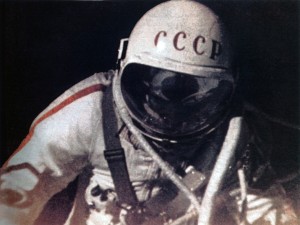
Alexi Leonov, Soviet cosmonaut during his spacewalk. Courtesy Vintagespace.files.wordpress.com

If the past is present, then it’s important that we understand the history of space exploration. At  Vintage Space, you can read an historical flash from the past in an article called Landings, NASA, and the Soviet Space Program, that explores the Soviet methods of getting astronauts safely back to Earth.

This week’s flashy news story (that turned out to be all mainstream-media handwaving, smoke and mirrors) about a Jupiter-like planet in the outer recesses of our solar system is Weirdwarp’s subject of discussion in Jupiter-like Planet Lurking Just Outside our Solar System is Extremely Unlikely. Guest poster Andrei (from ZMEScience) is a more sane and rational look at what the stories REALLY should have been about.

Next Big Future also presents a reasoned look at the outer solar system planet story in Tyche Planet X is still just a theory. Find out about the scientific paper by two respected scientists who posit the reasons why some long-period comet trajectories seem to have their comets coming from the wrong direction. Here’s your chance to go “behind the scenes” of a story that the MSM didn’t quite get right.

Nancy Atkinson at Universe Today talks with astronomer and planet hunter Mike Brown about that hypothetical giant planet lurking at the edge of the solar system to get his take on Tyche in About That Giant Planet Possibly Hiding in the Outer Solar System.

This week’s OTHER flashy news story, which covers events closer to Earth, turned out to be quite fascinating. It was the news about the Stardust-NExT mission to Comet Tempel-1.  I talk about the mission in a pair of back-to-back entries called Waiting for Tempel-1, written on “flyby night” and The Face of a Comet, posted the next day after some of the first images had been made public.

The COR1 coronagraph on the STEREO mission. Courtesy NASA.

At the center of our solar system, the Sun just keeps pumping out energy. Over at Vega 0.0, Francisco Sevilla writes about how coronagraphs enable astronomers to study the outer structures of the Sun’s superhot atmosphere. (Note the page is in Spanish, but you can translate using Google toolbar.)

Note: due to a software glitch, Astroblog’s entry didn’t make it in by the time I posted this. So, here is Ian Musgrave’s entry called The Kepler Bonanza: Making Sense of over 1,200 Extrasolar Worlds. Enjoy!

Over at Science Backstage, Italian science blogger and physicist Gianluigi Filippelli gives us a little “scientific baseball card” with important stats about the Sun and how it works.

Beer made from barley grains descended from barley that spent five months on the Zvezda Service Module on the International Space Station.

Finally, I mentioned a tasty beverage at the top of this entry. In that spirit, let’s raise a toast to National Geographic’s Breaking Orbit blog for its entry Space Beer Ready for Tasting.  It’s about Australia’s 4 Pines Brewing Company and its human experiment involving tasting beer that is meant for drinking on commercial space flights. Find out why some beers you may like here on the ground wouldn’t be so great in space.

That’s it for this week’s Carnival of Space. As you can see, there are many and talented writers who blog each day about astronomy, space science, and all the topics related to these.  If you like what you see, visit their blogs and let the authors know what you think!

Thanks for dropping by and keep looking up!
Waiting for Tempel-1

The Stardust-NExT Comet Watch

1:00 am. MST (0800 UT) February 15, 2010

As I sit here waiting for the first close-up images of Tempel-1 from the Stardust-NExT mission, I can’t help but recall the nights (it always seemed to be late nights) I sat at JPL during the Voyager missions to the outer planets, back in the 1980s. I was a science reporter at that point, and we all waited breathlessly, tiredly, but excitedly for images of the planets and their moons. Those pictures were coming from spacecraft virtually streaking past their targets, gathering images on the fly.

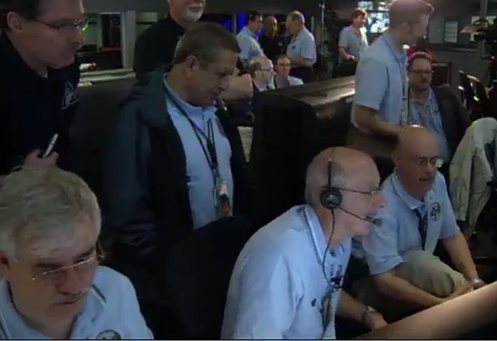
Stardust-NExT team members awaiting the first downloaded images from the mission.

Some years later, I went out to JPL again, this time to cover a couple of Mars missions.  One of them — the Pathfinder mission — was amazingly thrilling and it was like I imagined it must have been in the newsroom when the Viking spacecraft settled onto the surface of Mars. The first images from that distant world were amazing and we all were completely delighted with them.

The second mission to Mars that I covered was Mars Polar Lander. We waited breathlessly for the first data to come in… but it never did. The disappointment and grief that we all felt on the loss of that spacecraft were palpable throughout the rooms. We waited for days, hoping for a recovery, but it never came.

Anticipation builds as the first images arrive for processing.

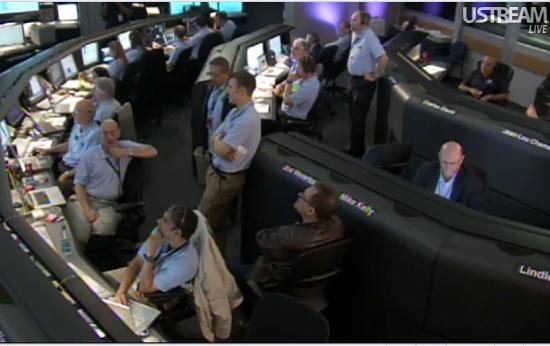
This experience has the same feeling of waiting and hopefulness. We already know that there WILL be images, because they are safely stored on the spacecraft and are on their way to Earth. So, no disaster awaits.  But there is one big difference for me, at least. This time, instead of sitting at JPL in a press room with dozens of other reporters and scientists, I’m at home, watching the mission unfold via DirecTV and NASA TV, as well as USTREAM via the World Wide Web. There’s a constant Twitter stream of commentary, plus a conversation on USTREAM, with people from around the world commenting.

Earlier this evening, I SKYPE’d with my old friend and colleague Kelly Beatty, whom I first met at JPL Voyager encounter. He, too, was sitting at home, watching the proceedings via the Web. We both joshed around about how it was so much easier to do this from home. All the excitement, none of the cross-country flights and jostling for space on overcrowded press tables.

Interestingly and poetically enough, the same press room that we used to work in at JPL is now a beautiful visitor’s center complete with a set of astronomy and space science exhibits that I wrote last year for JPL!

Well, back to the Stardust NExT mission.  The spacecraft made its closest approach to the comet a couple of hours ago (late on the 14th), passing within 200 kilometers of the nucleus of the comet. During that encounter, the dust sensors detected ‘hits’ from material streaming out from the comet. The “periscope” camera took 72 images of the nucleus, including five “bracketed” images at closest approach. Those are what we’re waiting on now. I’m watching the scientists live on screen, and once again, the feeling of anticipation and excitement is palpable, even through the cameras and the Web.

~1:45-2:00 am. MST (0845-0900 UT) February 15, 2010

Even though the first images were delayed due to an equipment swapout at Madrid and the spacecraft had to be re-instructed to send down the images, the wait was worth it. Just now, the scientists were told “The data you’re waiting for has been sent to you.”  They were told that all images were centered in the field of view, and in 15 minutes, we’ll see the first image as it comes out of processing.The closest approach image will be the second one downloaded and they have now told us that the distance to the comet in that image is 183 kilometers.

The scientists are cheerful, happy, and excited. I know they will be relieved, happy, and excited when the first pictures come up. This spacecraft and its mission have been part of their lives for years.

~2:16 a.m. MST (0916 UT) February 15, 2010

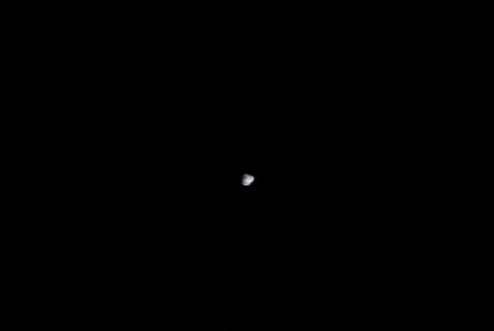
The first image in a sequence of more than 70 images of Comet Tempel-1, taken by the Stardust-NExT mission. Subsequent images will be from closer distances and show more detail. The good news is that the comet is centered in the camera's field of view!

The first image that the spacecraft took finally appeared just a few minutes ago. Contrary to what everybody has been expecting, it’s not the closest approach image. That, apparently will not “come down” for a few hours yet. The team has decided to let the spacecraft stream the images down in the order they were taken, which means that in about six hours, we should see the closest approach images.

This was not the order they were commanded to come down in — what they wanted to see FIRST were the close approach images. But, the spacecraft is doling them out one by one in “exposure order”, and we will all have to be patient.  Now, the good news is that the close-approach images will be down before the morning press conference, so we’ll all tune in then for some images and science.

This is how science sometimes works. You’re at the mercy of your instrument — and in this case, it’s an instrument out at a comet a few AU from Earth.  As the rest of the morning goes by, more images will show up.  I, for one, can’t wait to see them!  It may not look like much now, but just wait til we see the close-ups! For now, I’ll keep checking (as we all will) at the Stardust News site for the remaining pictures.  Stay tuned — this comet’s got a lot to tell us!