Category Archives: astronomy

Come With Me to the Starry City

And View it in Waves of Infrared Light

Astronomy takes you out there, thataway — and takes your breath away with cosmic visions of loveliness.  If it weren’t for the tools of astronomy that populate our spaceship of exploration, we’d still be seeing the universe in the equivalent of “black and white” TV of mid-last-century.  Those tools, like the Spitzer Space Telescope, with its infrared-sensitive detectors, open up the multi-wavelength universe and let us see things we weren’t able to see before.  Like the North American Nebula, in the constellation Cygnus, the Swan. Spitzer has just released some gorgeous imagery of this formerly mysterious region of space.

The first human to see the North American Nebula was William Herschel, back in 1786. It was merely a smudge to him, as it would be to anyone with a similar type of small telescope like he used.  I once tried to look at this nebula through a pair of fairly strong binoculars and through an 8-inch telescope, and it was faint, indeed. But, the shape of the nebula could be made out — it really does look like the outline of the North American continent.  However, this have changed since Herschel’s day. Today, we have telescopes and spacecraft that can look at wavelengths of light beyond the visible. Those have changed our perceptions of the cosmos.

Actually, what’s really changing is what we’re now able to see.  We’re detecting MORE of what’s in the nebula.  So, for example, we’re seeing infrared radiation given off by hot gas, for one thing. Inky black dust features seen in visible light are also heated, and they start to glow in the infrared view.

Different colors display different parts of the spectrum in each of these images. In the visible-light view (upper right) from the Digitized Sky Survey, colors are shown in their natural blue and red hues. The combined visible/infrared image (upper left) shows visible light as blue, and infrared light as green and red. The infrared array camera (lower left) represents light with a wavelength of 3.6 microns as blue, 4.5 microns as green, 5.8 microns as orange, and 8.0 microns as red. In the final image, incorporating the multi-band imaging photometer data, light with a wavelength of 3.6 microns has been color coded blue; 4.5-micron light is blue-green; 5.8-micron and 8.0-micron light are green; and 24-micron light is red.

This swirling landscape of stars is known as the North America nebula. In visible light, the region resembles North America, but in this new infrared view from NASA's Spitzer Space Telescope, the continent disappears. Where did the continent go? The reason you don't see it in Spitzer's view has to do, in part, with the fact that infrared light can penetrate dust whereas visible light cannot. Dusty, dark clouds in the visible image become transparent in Spitzer's view. In addition, Spitzer's infrared detectors pick up the glow of dusty cocoons enveloping baby stars. Clusters of young stars (about one million years old) can be found throughout the image. Slightly older but still very young stars (about 3 to 5 million years) are also liberally scattered across the complex, with concentrations near the "head" region of the Pelican nebula, which is located to the right of the North America nebula (upper right portion of this picture). Some areas of this nebula are still very thick with dust and appear dark even in Spitzer's view. For example, the dark "river" in the lower left-center of the image -- in the Gulf of Mexico region -- are likely to be the youngest stars in the complex (less than a million years old).

In the bottom two images, only infrared light from Spitzer is shown — data from the infrared array camera is on the left, and data from both the infrared array camera and the multi-band imaging photometer, which sees longer wavelengths, is on the right. These pictures look different in part because infrared light can penetrate dust whereas visible light cannot.

If you look back up at the “visible light” image of the nebula, you’ll see that it’s tough to make out those baby stars and the dusty cocoons where they formed. This is because they’re hidden by dark clouds, which are transparent to infrared light. This lets us peek behind the veil of gas and dust that hides star birth from us.

Baby stars are just part of the scene in the Spitzer image. We can see everything from the stellar cocoons where stars form to newborn stars sporting active jets to so-called “young adult” stars that are becoming more stable, and more capable of sustaining planetary systems.

There’s more to discover in this region of space. Not even Spitzer could reveal all the North American Nebula’s secret, hidden objects. Some of its clouds are just too dense for infrared to penetrate.  And, Spitzer now has no coolant left to chill down its detectors, so some of the longest wavelengths of infrared that it used to be able to detect are no longer available to it. But, that’s not stopping astronomers from studying these images and data. There’s still much to  learn from these observations. Stay tuned!
The Sun in Stereo

Two Perspectives

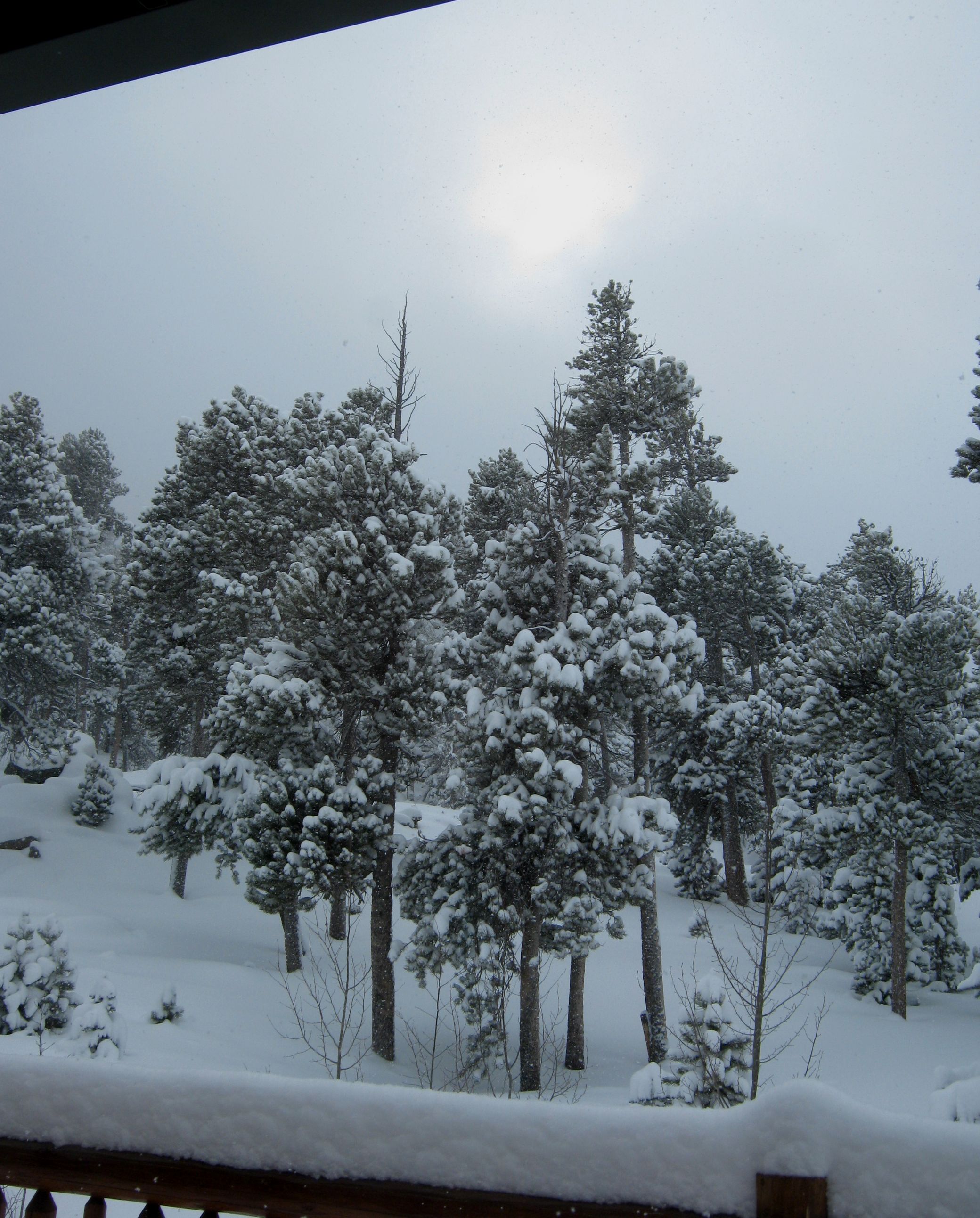
The is the Sun from my place on February 6, 2011.

Okay, everybody and his or her cat is jumping on this story about the Sun today — and for several good reasons:  1)  it’s great science about our nearest star and 2) it’s freaking cold out throughout much of the U.S. (and probably the rest of the Northern Hemisphere, and some of us will take any Sun we can get.

We get irrationally attached to that bright thing in the sky during the cold winter months — it’s our lifeline, the source of our warmth, and the hottest thing in the solar system. Small wonder we look for it after a few days of snow and when it shows up, some of us go outside and marvel at it (and the snowplows, who come, tank-like, to liberate us) after the storms.

But, there’s another perspective we can take on the Sun — and that’s our study of it as a star.  Sure, we all know it’s a giant sphere of superheated gases, plasmas if you will. And that heat is what powers the solar system, warms our planet, and bathes us in light.

That scientific perspective is what fuels today’s release of the STEREO mission’s first (darned-near-180-degree) view of the Sun. It shows us our nearest star in virtual stereo quality, as seen by two spacecraft that are studying it from opposite sites of Earth’s  orbit.

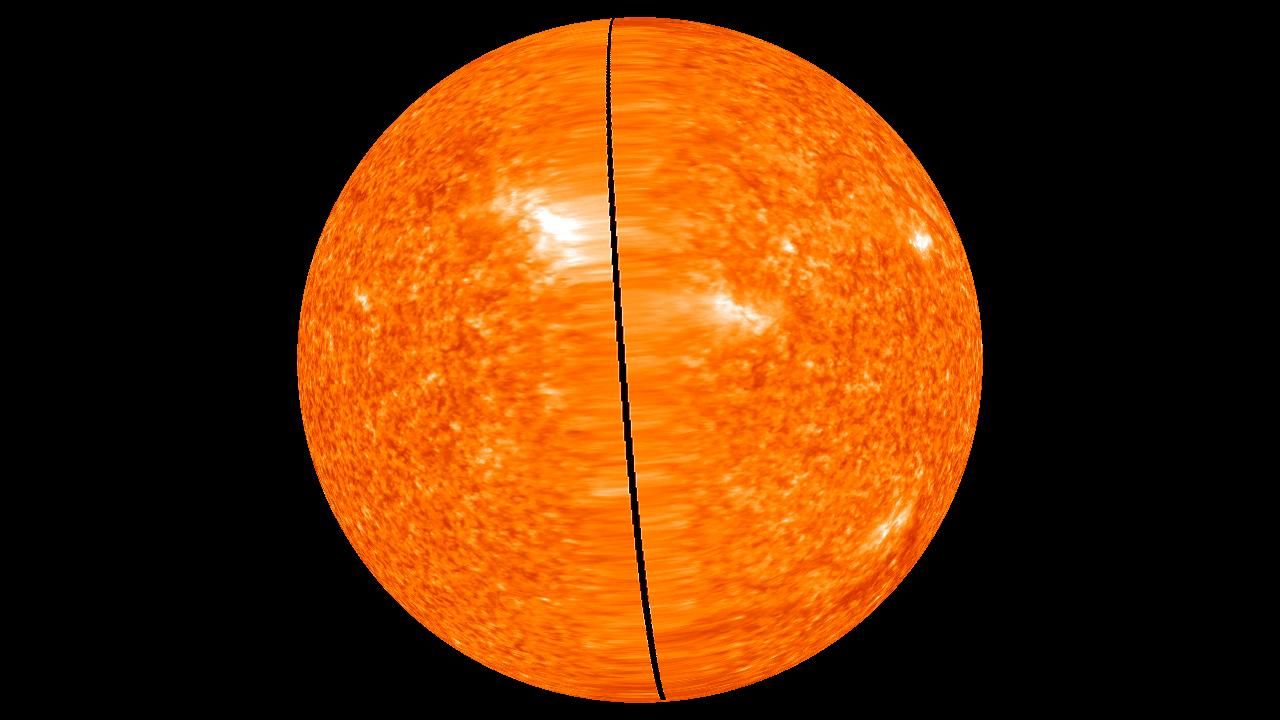
Latest image of the far side of the Sun based on high resolution STEREO data, taken on February 2, 2011 at 23:56 UT when there was still a small gap between the STEREO Ahead and Behind data. This gap will start to close on February 6, 2011, when the spacecraft achieve 180 degree separation, and will completely close over the next several days. Credit: NASA (Click to luxuriate.)

In the next few days, the STEREO spacecraft will be at a true 180 degrees apart (the images shown here were taken when the spacecraft were 179.7 degrees apart, and closing in on their final positions fast).

The image we see here is how STEREO sees the far side of the Sun. The first thing you notice is that line of black — that’s a data gap that will be closed when the two spacecraft are in their final positions. The true beauty of STEREO’s work is that it will allow scientists to study the Sun in true 3D.  It’s a big step forward for solar physics because 3D shows us that the Sun truly is a sphere of hot plasma, and that plasma gets woven and threaded through some incredibly intricate and ever-changing magnetic fields.

The action of those magnetic fields powers the incredible activity we see on the “surface” of the Sun and in it s superheated atmosphere. STEREO’s images and data are finally giving solar physicists the ability to fly around the Sun and study it year-round.

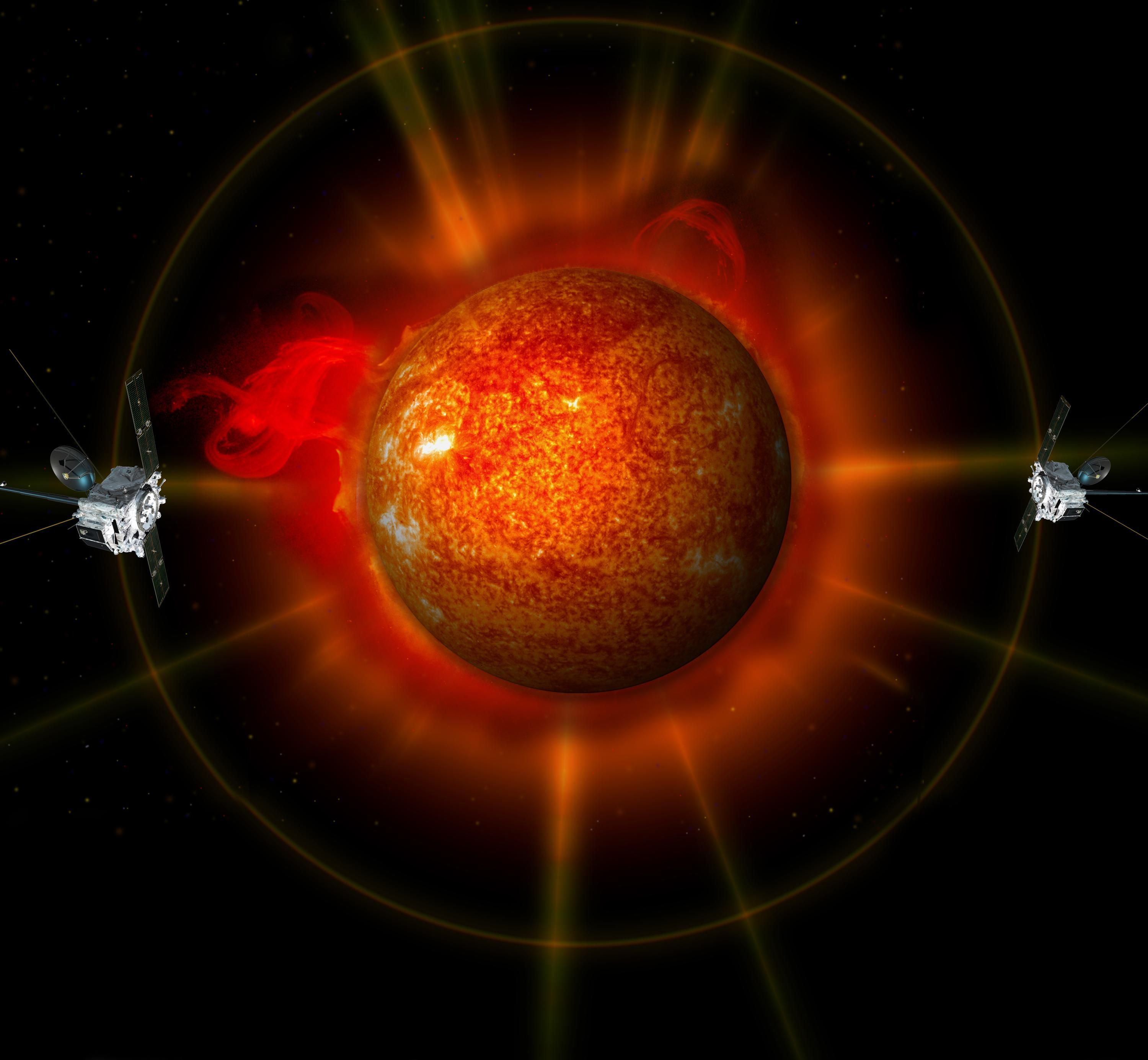
The STEREO spacecraft configuration. Courtesy NASA.

This is because the two spacecraft are at two separate points along Earth’s orbit and they virtually DO fly around the Sun over the course of a year, giving us a long-term view of our star and its activity.

Using STEREO, it is now possible to follow the evolution of an active sunspot or flare region on the opposite side of the Sun from Earth, all by using the twin spacecrafts’ abilities to see the Sun in both hemispheres. Scientists will be able to track that active region before it rotates around to face us — giving us plenty of time to take action if the activity is going to mess with our satellites, the ISS,  and power grids and telecommunications systems.

In fact, the National Oceanic and Atmospheric Administration’s Space Environment Laboratory is using data from the STEREO spacecraft to make ever-more-accurate models of outbursts from the Sun called “coronal mass ejections”. These explosions belch out huge masses of charged particles out from the Sun. They create what’s known as “space weather” — changes in the geomagnetic environment in near-Earth space. When those clouds of charged particles hit our planet’s magnetic field, the result can be as benign as a gorgeous display of northern or southern lights, or as disastrous as a power grid failure or fried satellite electronics. So, STEREO will be a huge help in predicting solar storms and helping us avoid the worst consequences of them.

Check out the STEREO web page for more images and cool videos.  And, keep following this story — there’s a LOT more we’re going to learn about the Sun from the STEREO perspective!

Finally, here’s a big shout-out to my old friend and grad school office “roomie”, Dr. Lika Guhathakurta. She’s the STEREO program scientist at NASA and I imagine she’s just thrilled with the data she and her team are seeing.  Hey Lika!  This one’s for you!