
…and Today’s Reality

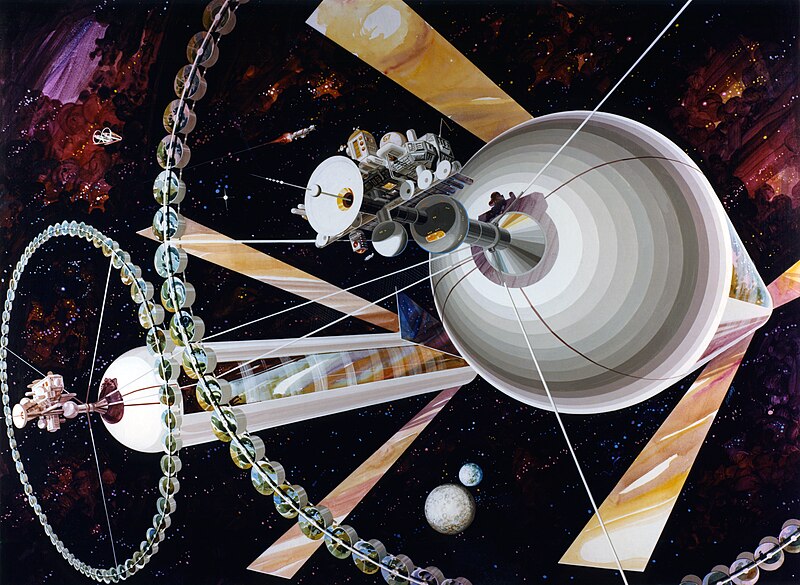
It’s always thought-provoking to read about plans to explore the Moon and Mars and build O’Neill Colonies at LaGrangian points in space and so on. These were once the stuff of science fiction — and in many ways they still are. But, the reality of lunar exploration, for example, is that it’s on the drawing boards and may actually happen in the next decade or so. Mars exploration? Robotic probes, sure. But, setting foot on Mars ourselves and tossing a few rocks into the bag before we start building colonies? That will take a little longer.
It’s not for lack of interest to do it. Not at all. There are many of us who would love to do it and we’re raising new generations of explorers to want to do it as well.
No matter who does it, these future exploration initiatives are really dependent on the physical, cultural and political will to do it and the proper amounts of infrastructure and money and people to do the work. We’re just now learning to live long-term in space and build structures (ISS). The way to Mars will be paved with a lot of complex, interlocking structures supplied by an international cooperative effort, and such an effort will take time to build and maintain as well.
I remember a long time ago hearing a conversation between a self-styled “expert” on space exploration and a radio talk show host. The “expert” was pontificating about how well the free market could be used to boost space exploration. His thesis: do some spectroscopy on Near-Earth asteroids and point out how they are chock full of stuff like gold and other precious metals and minerals, and maybe even some water, and by golly, Big Bidness will come flocking out to near-Earth space.
He just figured that companies would see that billions of dollars worth of wealth floating around out there in space and they’d rush right out to build the spacecraft to get there and grab the goodies.
As you might imagine, this guy had NO experience with such businesses, and his view of the pragmatism and altruism of big business when it comes to huge space-based ventures was naïve, to say the least. I’m quite certain that he was a firm believer in the idea of free markets to solve big problems.
Well.
In case anybody has been too buried in work or whatever to notice, the free market system has been taking quite a beating these days. Its boosters (always an optimistic bunch when there’s money to be made) are somewhat less than enthusiastic now that they’re seeing the downside of at least one law of free market physics–that is, what goes up can (and usually does) come back down, especially when there’s been some manipulation of complex investment vehicles and bad loans and excessive executive compensation and dicey credit arrangements and trade imbalances and so forth. And right now, we’re seeing all this come back to bite some Armani-suited posteriors. As it should. When the foxes are left to guard the henhouse, eventually folks with money to invest aren’t going to feel too confident about egg futures.

With markets being a bit shaken up now for Earth-based businesses, even the knowledge that asteroid 433 Eros (for example) is a walloping Mother Lode of shiny riches isn’t going to spur a big company like, oh say LockMart, to bootstrap a robotic pick and shovel to go out there and mine the ever-lovin’ bejeebers out of that asteroid.
It’s not that LockMart couldn’t do it (provided it could persuade its stockholders to fund such a thing), but the infrastructure to even begin building the thing isn’t ready.
Reality has a funny way of bringing us back to pay attention to what’s important. I’m not suggesting that our current market turmoil will get better if we just start funding missions to the Moon or the asteroids or Mars or whatever. All that stuff will happen, and when it does, the infrastructure building process will bring in new jobs, require more education and technology investment — all the things we need to keep a healthy economy going. But, it’s going to take some doing, and while we’re digging our way out of the current financial morass, it’s going to be important to keep our eyes on the prize of ongoing space exploration.
