
It was a Dark November Night…

And a Perfect One for Stargazing!

It’s hard to believe November is upon us already. Where I live we’ve already had snow, but interspersed with nice warm days now and then. November brings the first really cold weather for many of us in the Northern Hemisphere. Folks in the Southern Hemisphere are headed into summer, with much nicer weather.

For me, November always brings the chance to see Orion.  Of course, I have stay up pretty late to do that, since Orion’s still fairly low on the horizon much of the month at my usual 10 p.m. hour for stargazing. I always see Orion as a harbinger of winter. I just learned the other day from a friend’s Facebook post that the first sight of Orion was the occasion to do an Orion dance. I don’t know what kind of dance one should do, so I’d probably just go out, find Orion and maybe do a little impressionistic body movement. You could do Middle Eastern dance, or maybe a little tai chi, or if you’re a cosplayer, maybe a complete minuet, dressed in the appropriate court of Louis Quinze costume.  I think that, in the interests of aesthetics, however, you should probably steer clear of the Macarena.  Nobody wants to see you do THAT while stargazing. Although… it would be better than twerking. That “dance” is just so last month…

But I digress. November brings us planets to look at, the Moon, Comet ISON (in the wee hours for the first three weeks of the month), and the world-famous Leonid Meteor shower. It peaks around the 18th of the month. That one is best seen in the early hours of the morning, so if you want to do a Leonid part (complete with dancing), plan to stay up really, really, really late!  And dress warmly. Bring warm beverages.

I talk about the things you can explore in the November night skies in Our Night Sky an videocast on Astrocast.TV.  You watch it there, or see it here, at the bottom of this entry. Whatever you do, get out there (dress for the weather!) and get stargazing!

http://astrocast.tv/our-night-sky.html

Keeping Track of the Sky

The Stargazer’s Notebook

A portion of a wall painting showing what looks like Taurus the Bull, with the Pleiades over his back. Courtesy Wikimedia Commons.

People have been writing down what they see in the sky for almost as long as people have been LOOKING at the sky. There are credible archaeological finds showing drawings of constellations and other sky sights going back thousands of years. For example, the the  marvelous cave paintings at Lascaux, France, have a number of objects that appear connected to sky sights, including a painting of what looks like the Pleiades hovering over the back of Taurus the Bull.

4

The ancient Egyptians, Greeks, Akkadians, and many other cultures also n0ted sky events and objects by making carvings, writing on papyrus, and including them in paintings. The advent of formalized writing allowed people to make more detailed descriptions of what they saw in the sky. Succeeding generations of skygazers, philosphers, and scientists also wrote down what they saw in the sky, often sketching their visions to preserve them.

With the advent of photography, modern astronomy took the science of observation one step further, and the digital revolution enabled astronomers to save data from both ground-based and space-based observations. And, amateur astronomers have access to many of the same (or similar) software and hardware tools to record their skygazing.

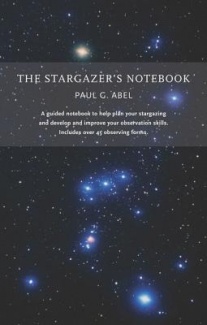
There are many stargazers who still like to record their views with sketches and notes. For them, Paul G. Abel has created a beautiful little book called The Stargazer’s Notebook. Abel is a Mathematics Teaching Fellow at University of Leicester in England, an astronomer, and a co-presenter on the BBC’s The Sky at Night show (which has a new broadcast slot after more than 40,000 people signed a petition to keep it on the air). His book has a gorgeous image of the constellation Orion on the cover, and is designed for observers at any level to record what they see in the sky. It provides several chapters of information about observing equipment, astronomy clubs, wish lists, observing planning pages, and much, much more. I could see this being a gift for a stargazer undertaking his or her first explorations of the sky. It’s always useful to get good observing and recording habits started at the same time you learn the sky, and an observing notebook like this one serves as a handy guide to the skies and beyond.

Exploring Science and the Cosmos

Spam prevention powered by Akismet