
It’s Earth-sized, It’s Rocky…

But, it’s Too Hot to Support Life

Artist's impression of the planet Kepler-78b and its host star. Art by Karen Teramura (UHIfA)
Artist’s impression of the planet Kepler-78b and its host star. Art by Karen Teramura (UHIfA)

It had to happen eventually—the discovery of an exoplanet with the same rocky-iron composition and size as Earth, but orbiting another star. The latest planet found orbiting another were first observed by the Kepler mission. Astronomers targeted this world, called Kepler-78b, for followup observations using the W.M. Keck Observatory on Mauna Kea, on the Big Island of Hawai’i. It lies about 400 light-years from Earth in the direction of the constellation Cygnus, the Swan.

The planet has some peculiar characteristics, as does its star, which rotates very slowly—about 1.5 meters per second. At that speed the star completes one rotation on its axis every 12.5 days. To give you an idea of how slow that is, a typical jogger goes about the same speed here on Earth. In addition, the parent star for Kepler-78b has star spots, which make it more difficult to suss out any possible planets. Astronomers had to do quite a bit of observational analysis to separate out the planet in the observations.

Kepler-78b has a radius of 1.2 times Earth’s, and has about 1.7 times Earth’s mass. It follows an 8.5-hour orbit which is incredibly fast compared to Earth’s 365-day trip around the Sun. For the planet to orbit that fast, it lies about 15,000,000 kilometers from its star.That’s amazingly close, which explains why this planet is too hot to support life.  Measurements indicate that the surface temperature of this planet is 2,000 degrees hotter than Earth’s (which can get as high as 57.7° C or 135° F)  By comparison, Mercury is the closest planet to the Sun, at at distance of 59 million kilometers. Its surface temperature gets as high as 630° C (1,140° F).  With such high surface temperatures, the surface of Kepler-78b could be a molten inferno.

As astronomers find more and more planets in the Kepler data, they’re able to classify them in different categories, such as “superEarths” and “hot Jupiters”. Kepler-78b is in a relatively new class called “ultrashort period planets. These are worlds discovered in Kepler observations that have orbital periods of less than 12 hours. They’re small, usually about one or two times the size of Earth, and all are so close to their planets that their surfaces are being scorched. It’s not clear how these rocky little worlds formed and survived in such close proximity to their stars.

This finding is just one of many discoveries flowing from the Kepler mission. Mechanical issues have ended the spacecraft’s most sensitive planet searches, but there is still plenty of work to do analyzing its vast treasure trove of information. Learn more about this most recent finding here. For more information about the Kepler telescope, visit the mission Web page.
Sgr A* Is a Hungry Black Hole

Chandra X-Ray Observatory Uncovers its Eating Habits

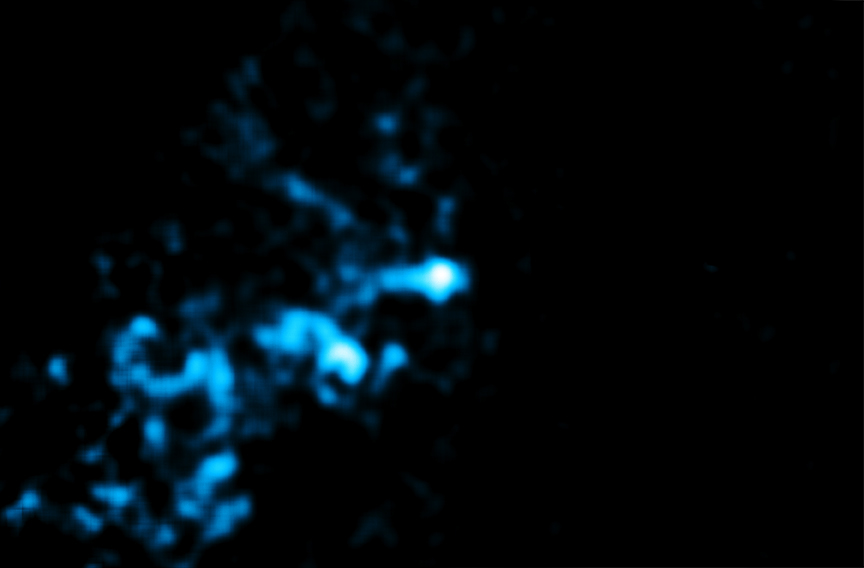
This image is from a new study of Chandra observations taken over twelve years that shows rapid variations in the x-ray emission from gas clouds surrounding the supermassive black hole. The phenomenon, known as a “light echo,” provides astronomers an opportunity to piece together what objects like Sgr A* were doing long before there were x-ray telescopes to observe them. Courtesy Chandra X-Ray Observatory team.

Our galaxy has a hungry supermassive black hole at its heart. It devours anything that happens to fall its way. Astronomers know that it has eaten a couple of times in the past few centuries and it’s doing it again right now. By studying x-ray emissions given off as the black hole eats, and measuring those emissions as they bounce off nearby clouds, astronomers can trace the eating habits of Sagittarius A* (the black hole’s name; Sag A* for short).

Over the past 12 years, astronomers using NASA’s Chandra X-ray Observatory have studied the central area of the Milky Way around the black hole. The data they took contains evidence that the normally dim region very close to Sgr A* has flared up with at least two very bright outbursts in the past few hundred years.

The astronomers watched rapid variations in the x-ray emission from gas clouds surrounding Sgr A*. So, how were the light-echoes produced? Astronomers suggest that they came about when when large clumps of material, possibly from a disrupted star or planet, fell into the black hole. Some of the x-rays then bounced off gas clouds about 30-100 light-years away from the black hole. Just as echoes of sound reverberate long after a noise is created, light echoes in space replay the original event.

While light echoes from Sgr A* have been seen before in x-rays by Chandra and other observatories, this is the first time that evidence for two distinct flares has been seen within a single set of data. The light echoes suggest that the area very close to Sgr A* was at least a million times brighter within the past few hundred years. X-rays from the outbursts (as viewed in Earth’s time frame) that followed a straight path would have arrived at Earth at that time. However, the reflected x-rays in the light echoes took a longer path as they bounced off the gas clouds and only reached Chandra in the last few years. This is how scientists know that Sgr A* has been snarfing down material that falls its way. And, it doesn’t do it quietly. Producing x-rays implies a tremendous amount of energy is released each time the black hole gobbles up material.

If you want to know more about how the astronomers studied these emissions, check out the full story on the Chandra web pages. And, stay tuned. Astronomers are tracking an other cloud of gas and dust that is headed for Sgr A*. It is arriving about now, and will take about a year to be fully assimilated into the collective that is Sgr A*. Observatories are geared up to watch the region around the black hole light up as this three-solar-mass cloud of material heads into oblivion.

Exploring Science and the Cosmos

Spam prevention powered by Akismet